Descriptions and comments by the aces who flew them.
P-51 North American Mustang
Generally considered to be the best fighter of WWII
"The day I saw Mustangs over Berlin, I knew the jig was up." Hermann Goering
15,100 planes produced, starting in June, 1942.
P-51D specs: 440 MPH, six 50 caliber machine guns
North American Aviation originally designed the Mustang in response to a British specification. They agreed to produce the first prototype only 4 months after signing the contract in April 1940 (and met that commitment). And by the end of 1941 North American had delivered the first Mustang to England for test flights. These first Mustangs were powered by the Allison V-1710 engine, a good engine, but one which didn't operate well at high altitudes.
In April, 1942, a British test pilot, Ronald Harker flew the Mustang and was very impressed by it. But he suggested that the new plane would be a natural fit with the Rolls Royce Merlin 60 engine, which operated very well at high altitudes. At the prodding of Major Thomas Hitchcock, the Americans began working along the same lines (using the Packard license-built version of the Merlin), and the first Merlin-equipped Mustang, the P-51B, flew in November, 1942. The results were impressive, to say the least. At 30,000 feet, the improved Mustang reached 440 MPH, almost 100 MPH faster than the Allison-equipped Mustang at that altitude.
Both Robert Goebel and Bud Anderson flew Mustangs. Their comments follow.
Bud Anderson on the P-51:
When Bud Anderson arrived at Raydon Wood in England, with the 357th Fighter Group. Here he was introduced to the Mustang, which was a lot different from the P-39. The Mustang was a tail-dragger with a long nose blocking the pilot's forward view, requiring him to make sweeping "S" turns to see where he was going. The P-51 was a lot more powerful, and had a big four-blade paddle propeller. Take-offs and landing were a bit tricky, but in the air, the Mustang
was pleasant and forgiving to fly. Best of all, it went like Hell. The Merlin had great gobs of power, and was equally at home high or low, thanks to a two-stage, two-speed supercharger. The Mustang carried fuel enough to pursue and destroy the enemy once you'd flown to the target, and it could turn on a dime. It was crucial to keep it it trim but, as we gained experience with the plane, that became automatic. We sensed it was special, even before we measured it against what the enemy pilots were flying.
quoted from To Fly and Fight, available from Amazon.com
Bob Goebel on the P-51:
Robert Goebel flew Mustangs with the 31st Fighter Group, based at San Severo, Italy, in the MTO (Mediterranean Theater of Operations). Like Bud Anderson, he had flown P-39s earlier on. At San Severo in mid-1944, he got his first crack at the P-51:
We soon found out that the P-51 Mustang was indeed a different breed of airplane. It was fast, for one thing. ... The P-51 was redlined at 505 and, though it was no Spitfire, its turning ability wasn't bad at all - especially if you sneaked down 10 degrees of flaps. It was pretty good in the climbing department too, and accelerated very fast in a dive. But the thing that really set the Mustang apart from any other fighter, friend or foe, was its range. With a 75-gallon tank slung under each wing, it could perform the unheard-of: It could fly six-hour missions.
Physically, it was pleasing to the eye and looked fast, even sitting on the ground. Power was provided by a V-1650 Rolls-Royce Merlin engine built under license in the States by Packard, the luxury automobile company. The V-1650 was a fine engine and could be taken up to 61 inches of manifold pressure at 3,000 RPM for take-off or, if needed in combat, 67 inches for up to five minutes in Emergency Power. Normally aspirated engines tended to run out of power as altitude increased, usually between 15,000 and 20,000 feet. The P-51 had a two-stage blower in the induction system that was controlled automatically with a barometric switch. Around 17,000 feet, when the throttle had been advanced almost all the way forward just to maintain normal cruise, the blower would kick into high, the manifold pressure would jump up, and the climb could be continued to 30,000 feet. The P-51 could be taken a lot higher than that, but above 30,000 feet the power was way down and the controls had to be handled gingerly.
Quoted from Mustang Ace available at Amazon.com
The Mustang's range and combat capabilities permitted it to escort the heavy USAAF bombers (B-17s mostly) on massive daylight bombing raids over Germany. Some have argued that it was a "war-winning" weapon. It certainly was a decisive factor in the aerial Battle of Germany. After World War Two, the Mustang continued to serve with the USAAF and other Western air forces, including distinguished service in the Korean War.
Recommended Web Site: Joe Baugher's P-51 article - another excellent and detailed aircraft article by Joe Baugher
Recommended Reading (available from Amazon.com): Mustang Aces of the Eighth Air Force
Recommended Reading (available from Amazon.com): Mustang Aces of the Ninth and Fifteenth Air Forces and the RAF
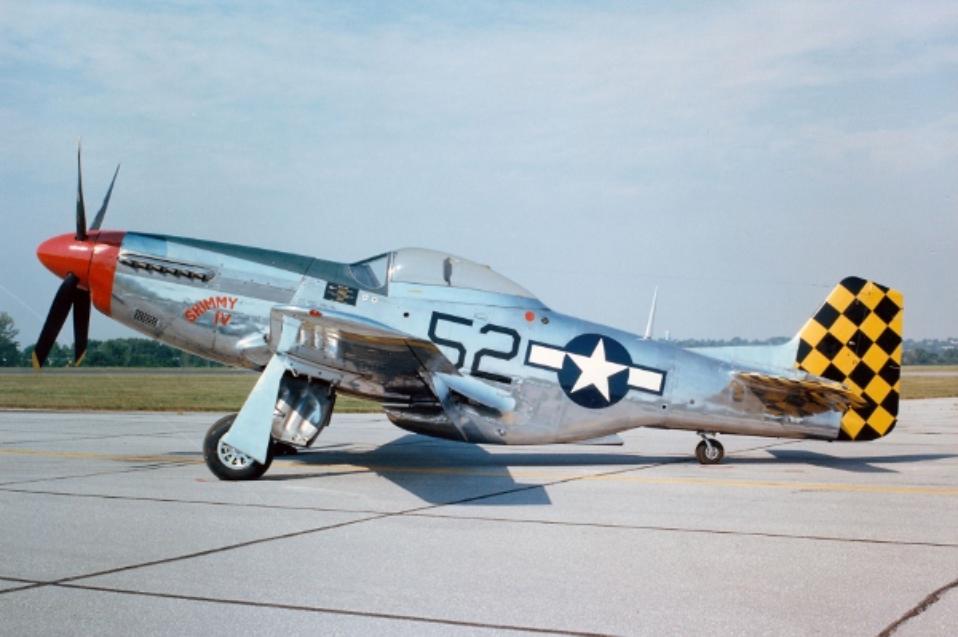
Among one of the most famous fighters of World War II, the P-51 Mustang has its roots in both Britain and the USA. Originally overlooked by the USAAF, the P-51 did not see action with American forces until March 1943. Once its full potential had been developed, the USA realized that this aircraft had been ignored for far too long a time. With the forging of the American airframe with the British Rolls-Royce Merlin ( Rolls-Royce Merlin ) engine, it would be unmatched by any other piston aircraft of World War II.
In late 1939, with the likelihood of full scale war in Europe a major concern, the British Royal Air Force was looking seriously at methods of quickly increasing its fighter strength. In April 1940, the British Air Purchasing Commission approached North American Aviation with the intent of having them build Curtiss P-40's for the RAF. Since the P-40 design went back to 1933, James H. "Dutch" Kendelberger, the president of North American offered to build an entirely new advanced fighter using the same Allison V-1710-39 engine used on the P-40. It was said that "Dutch" got his inspiration for the P-51 after a 1938 tour of aircraft industries in Great Britain and Germany.1 North American's only previous fighter experience was with the NA-50A, but Dutch collaborated with J.L. "Lee" Atwood2 to formulate an outline for the project. The British agreed on the new type, NA-73X, only on the stipulation that a prototype be on hand within 120 days. North American designers Raymond Rice and Edgar Schmued, the latter had worked for Fokker and Messerschmitt in 1925,3 immediately set about meeting the requirements. A prototype was finished in 117 days minus the engine. Wheels also had to be borrowed from an AT-6 trainer. Six weeks later after several modifications, the aircraft took to the air October 26,1940.4 With Vance Breese at the controls, who was one of the most famous test pilots in his day, the XP-51 reached 382 mph, exceeding the P-40's top speed by 25 mph.5 The P-51 was an immediate success and it even outperformed the Spitfire.
Unique to the P-51 was the laminar flow wing design which was developed by the US National Advisory Committee for Aeronautics (NACA). Contemporary aircraft wings featured a wing cross-section with maximum thickness about a fifth of the way across the wing from the leading edge with most of the camber on top of the wing. The laminar flow wing in contrast has its maximum thickness well aft from the leading edge and has almost as much camber on top as on the bottom. This feature reduced turbulent flow across the wing, thereby reducing drag and increasing speed and range. Drag was also reduced by positioning a ventral radiator underneath the rear of the fuselage to present the smallest possible fuselage cross section. The British Purchasing Commission was enthusiastic about the plane and confirmed a production order for 320 Mustang Is. This was later increased by 300 for NA-83s which differed only in minor details; the British designation was Mustang IA.7 Powered by the 1,100 hp Allison V-1710-39 engine, the airplane's performance was only impressive up to 15,000 ft. However, performance would be dramatically improved once the airframe was matched with the Rolls-Royce Merlin engine. This is not to say that the Allison wasn't a good engine as it performed very well on the Lockheed P-38. The problem with the Allison had more to do with the USAAF's heavy reliance on turbosupercharging. This requirement was impossible to meet for all aircraft due to a shortage of metal alloys such as tungsten. There was some experimentation with turbo-supercharged P-40s by designer Donaldson R. Berlin and these planes outperformed the Spitfire and Messerschmitt Bf 109.
When the Rolls-Royce Merlin engine was installed in the P-51B, it dramatically improved the performance of the Mustang.
During the design stage, on May 4, 1940, the US Army released the design for export with the condition that two of the planes be delivered to them for evaluation. At this time, the NA-73 was assigned the XP-51 designation. The first and tenth airframes were sent to the Army for testing and were given the serial numbers 41-38 and -39. An order for 150 P-51s followed which was to satisfy the RAF request as part of the Lend Lease legislation. After Pearl Harbor, fifty-three of these were kept back as reconnaissance aircraft. Initially, the P-51 was named "Apache" for a short time, but the name "Mustang" was later adopted. The British designation would be Mustang I. Most of the first 20 Mustangs to arrive in England were used for test and evaluation.
It wasn't until 1942 that the USAAF decided to order 310 P-51As and 300 ground attack/bomber A-36A Mustangs. The reason for the delay in procurement of the type was for somewhat murky reasons, uncovered during an inquiry known as the Truman Report.9 The demand for kick-backs was refused by Dutch Kindelberger in order to get a production award. "Ultimately, even those who sought to block the procurement could not sustain their position, because of the obvious qualities of the airplane."10 The P-51A had an Allison V-1710-81 engine which developed 1,200 hp for takeoff and increased maximum speed to 390 mph. The British designation for the P-51A was the Mustang II and fifty were delivered late in 1942.
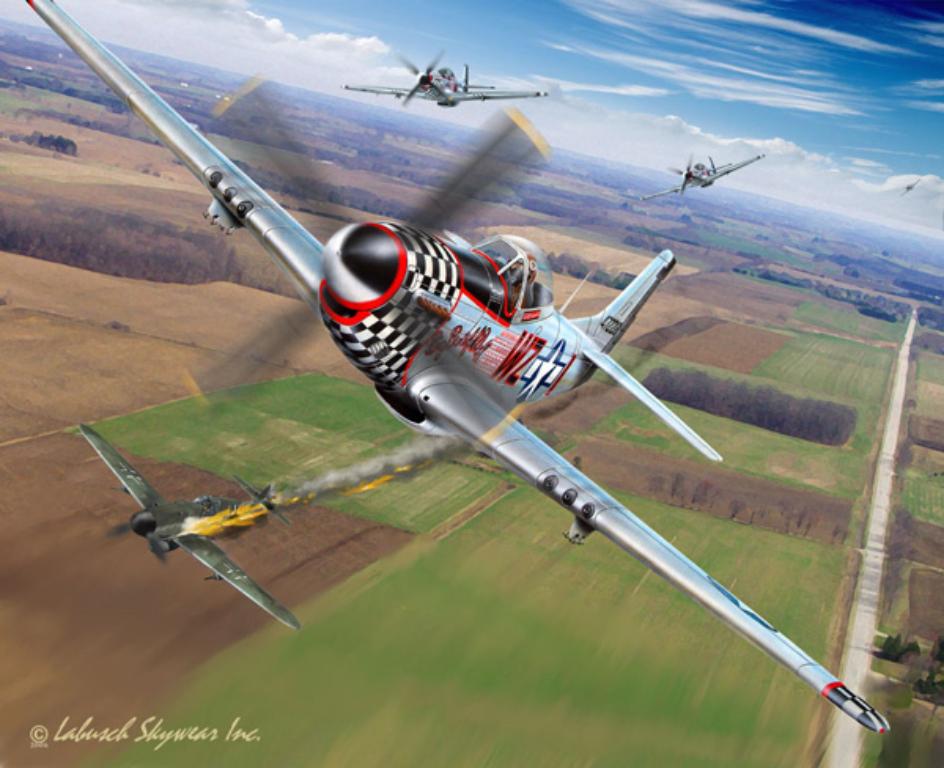
With the limitations for fighter duties due to the Allison engine, nevertheless the Mustang had good ground attack potential and its high speed at low altitude made it ideal for tactical reconnaissance. To enhance altitude capabilities, a mockup was devised in England to use the Rolls-Royce Merlin engine in the P-51 airframe. One concept was to locate the new engine behind the cockpit, but this idea was rejected and the Merlin was mounted in the conventional position in the nose. Four airframes were adapted in England to take the Merlin engine. These four planes known as Mustang Xs had deep intakes below the engine for carburetor air. The results of the British tests were passed on to North American. In the meantime, North American had undertaken a similar conversion project and was building two Packard Merlin-powered Mustangs. The level airspeed increased by 51 mph, to 441 mph. The airframes were strengthened to accommodate the extra power, the ventral radiator was deepened and the carburetor intake was moved from above the nose to below, to accommodate the Merlin updraft induction system.11 Even before the Army's Merlin powered Mustangs had flown, the US Army ordered 2,200 of the more powerful fighters. For a short time, this model was designated P-78, then redesignated as P-51B. 25 P-51Bs and 275 P-51Cs were given the British designation Mustang III. The California Mustangs were known as the P-51B-NA and the Dallas, Texas facility produced the P-51C-NT.12 The Merlin powered P-5lB and its Dallas-built twin, the P-51C, began operations in December 1943.
A further improvement to the Mustang was introduced when a graceful teardrop canopy was installed to eliminate the dangerous blind area created by the faired cockpit. First tested on two P-51Bs, they became standard on the P-51D and all later models. 280 P-51Ds were given the RAF designation Mustang IV. The P-51D became the version produced in the greatest quantities with 7,954 being completed. The P-51D model carried six .50 caliber machine guns with a total of 1,880 rounds instead of the four guns mounted in the P-51Bs. Other refinements, such as moving the wing forward slightly and provisions for rocket launchers were included. The first P-51Ds types were delivered without dorsal fins, but this feature was added to compensate for keel-loss when the bubble canopy was adopted.
The P-51D with the dorsal fin represented the most typical Mustang configuration. The wingspan was 37 feet with an area of 233 square feet and was 32 feet 3 inches long. Height was 13 feet 8 inches. The Packard-built Merlin V-1650-7 was capable of delivering 1,695 hp which provided a speed of 437 mph at 25,000 feet. Weights were 7,125 lbs. empty and 10,100 lbs. normal gross, but an additional 2,000 lbs. could be carried. Internal fuel capacity was 105 gallons, giving a range of 950 miles at 362 miles per hour at 25,000 feet.
The P-51H series was the final production type that included several changes making it the fastest production variant with a maximum speed of 487 mph at 25,000 feet. Five hundred fifty-five P-51H's were delivered before VJ Day out of an original order for 1,445 machines.13
To say P-51 Mustangs were successful would be an understatement. It is considered to be the best piston aircraft of World War II and became one of the world's aviation elite. A total of 14,819 Mustangs of all types were built for the USAAF. American Mustangs destroyed 4,950 enemy aircraft making them the highest scoring US fighter in the Europe Theater of Operations. They were used as dive-bombers, bomber escorts, ground-attackers, interceptors, for photo-recon missions, trainers, transports (with a jump-seat), and after the war, high performance racers.
| Specifications: | |||
|---|---|---|---|
| North American P-51 Mustang | |||
| Dimensions: | |||
| P-51A | P-51B | P-51D | |
| Wing span: | 37 ft (11.27 m) | 37 ft (11.27 m) | 37 ft (11.27 m) |
| Length: | 32 ft 3 in (9.82 m) | 32 ft 3 in (9.82 m) | 32 ft 3 in (9.82 m) |
| Height: | 12 ft 2 in (3.70 m) | 13 ft 8 in (4.16 m) | 13 ft 8 in (4.16 m) |
| Weights: | |||
| Empty: | 6,433 lb. (2,918 kg) | 6,985 lb. (3,168 kg) | 7,125 lb. (3,232 kg) |
| Gross: | 8,600 lb (3,901 kg) | 9,800 lb (4,445 kg) | 10,100 lb (4,581 kg) |
| Max T/O: | 9,000 lb (4,082 kg) | 11,800 lb (5,352 kg) | 11,600 lb (5,262 kg) |
| Performance: | |||
| Max Speed: | 390 mph (628 km/h) | 440 mph (708 km/h) | 437 mph (703 km/h) |
| Ceiling: | 31,350 ft. (9,555 m) | 42,000 ft. (12,802 m) | 41,900 ft. (12,771 m) |
| Range: | 350 miles (563 km) | 1,300 miles (2,092 km) | 950 miles (1,529 km) |
| Max Range: | 2,550 miles (4,104 km) | 2,080 miles (3,347 km) | 2,300 miles (3,701 km) |
| Powerplant: | ||
|---|---|---|
| P-51A | P-51B | P-51D |
| Allison V-1710-81 1,200 hp, 12 cylinder V engine. | Packard Merlin V-1650-3/7 1,380/1,420 hp, two-staged supercharged, 12 cyl. V engine. | Packard Merlin V-1650-7 1,695 hp, two-staged supercharged, 12 cyl. V engine. |
| Armament: | ||
| Four .50 caliber machine guns, external bomb load of 1,000 lbs. (453 kg.) | Four .50 caliber machine guns, external bomb load of 2,000 lbs. (907 kg.) or drop tanks. | Six .50 caliber machine guns, external bomb load of 2,000 lbs. (907 kg.) or four .5 inch rockets. |
