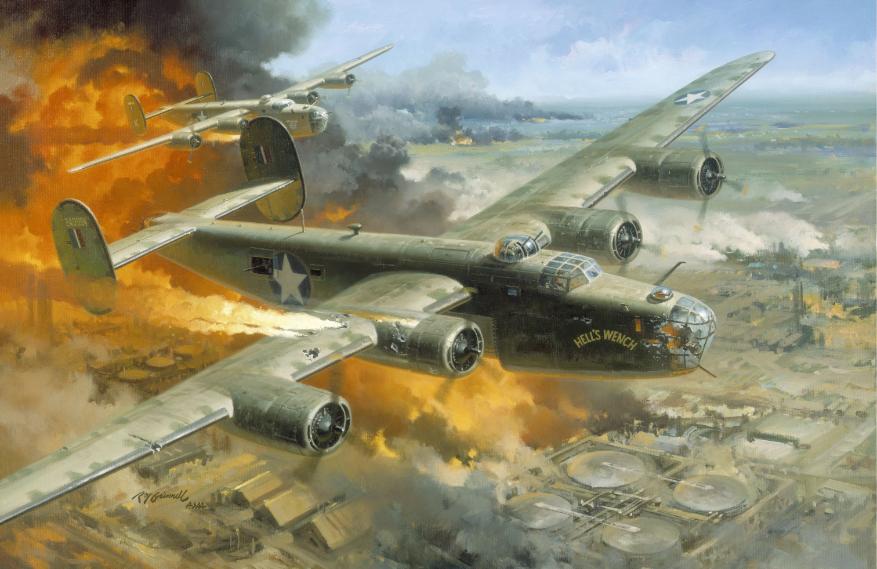
The Consolidated B-24 Liberator was produced in larger numbers than any other American military aircraft, and was the first American aircraft to enter mass production, but despite this the Liberator is still less well known than the Boeing B-17 Flying Fortress or the B-29 Superfortress. Each of these aircraft gained their fame by being closely associated with a particular campaign – the B-17 with the Eighth Air Force bombing campaign over Europe and the B-29 with the bombing of Japan. In fact even by the end of the war the B-24 Liberator equipped nearly a third of the Eighth Air Force's heavy bomber units, fifteen groups of the Fifteenth Air Force, operating from Italy, and was serving in just about every part of the war against Japan, from India to Alaska. In total 18,188 Liberators were built, and at its peak in September 1944 6,043 aircraft were on the strength of the USAAF, equipping forty five groups.
The LB-30 designation was inherited from an original French order for a heavy bomber. The French had issued the specification for this aircraft in May 1938, and Consolidated had responded with the Model 30, a land bomber based on their Model 29 flying boat, thus LB-30. By the time the French placed an order for the aircraft, in June 1940, Consolidated had moved on to the Model 32 (or XB-24), and it would be this aircraft that would be delivered to the RAF as the LB-30A (some sources suggest that LB stood for Liberator, British, but if this was the case, then one would expect the aircraft to have been either the LB-32, to match the model number for the B-24, or LB-24 to match the B-24).
Model 31
A key element in the design of the B-24 was the Davis wing. This was a wing based on the shape formed by a falling raindrop, and produced long, thin but very efficient wings. Consolidated first used the Davis wing on their Model 31 flying boat (given the Naval designation XP4Y). This was a twin engined, twin tailed aircraft, which proved to be far superior to the Consolidated PBY-3 Catalina,
Model 32
Both the twin tail and the Davis wing would be carried over to the design of Consolidated’s Model 32. This aircraft was produced to satisfy an Army Air Corps specification for a bomber with a range of 3,000 miles, a top speed of 300 mph and a maximum bomb load of 8,000lbs. The aim was to produce an aircraft with a superior performance to the Boeing B-17 Flying Fortress.
The Davis wing was not the only advanced feature of the Model 32. It also featured a tricycle landing gear – one wheel in each wing and the third wheel in the nose, rather than in the tail as was more common. This arrangement allowed for faster landings and take-offs, and made better use of the Davis wing, but did require the pilots to adapt a new method of landings and taking off, which in some cases caused accidents. Air Force statistics show that the B-24 suffered more accidents for every 100,000 hours in the air than the B-17 – 75 vs. 55 in 1942, falling to 29 vs. 23 in 1945, although both types were much safer than the single engined fighters.
The aircraft had a large fuselage, capable of carrying eight 1,000lb bombs in two rows of four in the bomb bay, twice the capacity of the B-17. This extra space would make the B-24 a much more versatile aircraft.
XB-24
Liberator I
On 30 March 1939 Consolidated were awarded a contract to produce one XB-24 prototype aircraft, and given nine months to build it. The aircraft was ready eight months and 28 days later. It made its first flight on 29 December 1939, and the flight tests soon proved that the new aircraft did indeed have superior range to the B-17, 200 miles longer when fully loaded. To a certain extent this longer range would prove to be illusory. The XB-24 was un-armoured and lacked self-sealing fuel tanks, both of which had to be added to make the aircraft truly combat ready.
The XB-24 was originally powered by Pratt & Whitney R-1830-33 engines, with mechanical two-speed superchargers. In early tests these failed to achieve the expected speeds, and so were replaced with R-1830-41 engines with GE B-2 turbo-superchargers. The aircraft had been built with leading edge wing slots, but these were also removed during the testing process.
The aircraft was given the Liberator name by the Consolidated workforce. A contest was held at the San Diego factory, which is said to have been won anonymously by Dorothy Fleet, the wife of the company’s founder. In a reversal of the normal pattern at this date, this name was then adopted by the RAF.
The French Order
At the outbreak of the Second World War the French Air Force was desperately short of modern aircraft. In an attempt to fill the gap a number of orders were placed for American aircraft. Amongst them was the first production order for B-24s, for 120 B-24As, under the designation LB-30MF. These were to be armed with two .30in guns in the tail and single .50in guns in the waist and nose positions. None of these aircraft had been delivered before the fall of France. The order was split between the RAF and the USAAC. Britain received six LB-30As, twenty Liberator Is (LB-30Bs) and a number of Liberator IIs, with the remaining aircraft going to the USAAC, nine as B-24As. The rest were completed as B-24Cs and B-24Ds.
YB-24
Although the Army ordered seven YB-24 service test aircraft on 27 April 1939, only one was actually built. The remaining six aircraft were completed as B-24Ds. Another six aircraft were completed to the YB-24 standard and were provided to the British, where they were given the designation LB-30A and used as long range transport aircraft. All thirteen of these aircraft were built using airframes that had originally been intended for the French order.
The single YB-24 was similar to the XB-24B, featuring self sealing fuel tanks and spinners on the propeller hubs. The only significant changes made to the design were the removal of the leading edge slots from the wings and the installation of de-icing boots on the leading edge of the wings and tail surfaces.
Comparison to the B-17
The B-24 is inevitably compared to the B-17. The Liberator could carry a higher bomb load over longer distances than the B-17, although as the B-24 gained armour, self sealing tanks and more guns and the B-17 gained longer range the gap closed. It still had enough of an edge to make it the bomber of choice in the Pacific, where it took part in some of the longest raids of the war, the 2,400 mile round trips to Balikpapan.
Statistically the B-24 had a slightly lower loss rate than the B-17, but it was felt to be less rugged than the B-17, and the Davis wing would prove to be prone to collapse completely if damaged. As the aircraft gained in weight, the stability of the aircraft suffered and it became harder to hold the B-24 in the rigid box formations called for over Europe.
The larger fuselage of the B-24 meant that it was always more flexible than the B-17. It was much suitable for use as a cargo plane or transport plane (C-87) and as a fuel tanker (C-107). Its initially longer range also gave it an advantage as a long range naval patrol aircraft, although here the lack of stability could be a real disadvantage, making it a tiring aircraft to fly.
Consolidated B-24D Liberator lost during Operation Tidalwave
Consolidated B-24D Liberator lost during Operation Tidalwave
In one area the B-24 was clearly inferior to the B-17. That aircraft had been designed in the interwar years, and some attention had been paid to crew comfort. Early versions could carry bench seats in the rear fuselage, access was via doors in the fuselage, and each crewman had a clear station. In contrast access to the B-24 was haphazard, with most crewmen clambering in via the bomb bay or the nose wheel door opening. The navigator lacked a dedicated position and tended to occupy either the nose or share the radio operator’s position. The nose position and turrets were not manned during take off or landing, as the nose wheel was prone to collapse, making those positions rather vulnerable. In one area the B-24 did outscore the B-17 – if the ventral ball turret got stuck in the down position, on the B-17 there was a real danger of it being crushed in a bad landing, but the B-24 was more likely to end up nose-down, with the ball turret safely up in the air! In the end most aircrew grew to love the aircraft they were flying, because it was that aircraft that kept them alive.
General characteristics
Crew: 11 (pilot, co-pilot, navigator, bombardier, radio operator, nose turret, top turret, 2 waist gunners, ball turret, tail gunner)
Length: 67 ft 8 in (20.6 m)
Wingspan: 110 ft 0 in (33.5 m)
Height: 18 ft 0 in (5.5 m)
Wing area: 1,048 ft² (97.4 m²)
Empty weight: 36,500 lb (16,590 kg)
Loaded weight: 55,000 lb (25,000 kg)
Max. takeoff weight: 65,000 lb (29,500 kg)
Power plant: 4 × Pratt & Whitney R-1830-35 or -41 turbosupercharged radial engines, 1,200 hp (900 kW) each
Zero-lift drag coefficient: 0.0406
Drag area: 42.54 ft² (3.95 m²)
Aspect ratio: 11.55
Performance
Maximum speed: 290 mph (250 kn, 470 km/h)
Cruise speed: 215 mph (187 kn, 346 km/h)
Stall speed: 95 mph (83 kn, 153 km/h)
Range: 2,100 mi (1,800 nmi, 3,400 km)
Ferry range: 3,700 mi (3,200 nmi, 6,000 km)
Service ceiling: 28,000 ft (8,500 m)
Rate of climb: 1,025 ft/min (5.2 m/s)
Wing loading: 52.5 lb/ft² (256 kg/m²)
Power/mass: 0.0873 hp/lb (144 W/kg)
Lift-to-drag ratio: 12.9
Armament
Guns: 10 × .50 caliber (12.7 mm) M2 Browning machine guns in 4 turrets and two waist positions
Bombs: Short range (˜400 mi): 8,800 lb (3,600 kg)
Long range (˜800 mi): 5,000 lb (2,300 kg)
Very long range (˜1,200 mi): 2,700 lb (1,200 kg)
Introduction to service, 1941–42
The United States Army Air Forces (USAAF) took delivery of its first B-24As in mid-1941. The USAAF initially used the type as transports. The sole B-24 in Hawaii was destroyed by the Japanese attack on Pearl
Harbor on 7 December 1941.
The first USAAF Liberators to carry out combat missions were 12 repossessed LB-30s deployed to Java with the 11th Bombardment Squadron (7th Bombardment Group) that flew their first combat mission in mid- January. Two were shot up by Japanese fighters, but both managed to land safely. One was written off due to battle damage and the other crash-landed on a beach.
US-based B-24s entered combat service in 1942 when on 6 June, four B-24s from Hawaii staging through Midway Island attempted an attack on Wake Island, but were unable to find it.
Strategic bombing, 1942–45
On 12 June 1942, 13 B-24s flying from Egypt attacked the Axis-controlled oil fields and refineries around Ploieti, Romania.
Over the next three years, B-24 squadrons deployed to all theaters of the war: African, European, China-Burma-India, the Battle of the Atlantic, the Southwest Pacific Theater and the Pacific Theater. In the Pacific, the B-24 (and its twin, the U.S. Navy PB4Y Privateer) was eventually designated as the standard heavy bomber to simplify logistics and to take advantage of their longer range, replacing the shorter-range B-17 which had served early in the war along the perimeter of the Pacific from the Philippines, Australia, Espiritu Santo, Guadalcanal, Hawaii, and during the Battle of Midway from Midway Island.
While pilots who flew both preferred the B-17, the B-24 was faster, had longer range, and could carry a ton more bombs.[24] It was one of the workhorse bombers of the U.S. Eighth Air Force in the Combined Bomber Offensive against Germany, forming about one-third of its heavy bomber strength, with the other two-thirds being B-17s. Thousands of B-24s, flying from bases in England, dropped hundreds of thousands of tons of high explosive and incendiary bombs on German military and industrial targets. The 44th Bombardment Group was one of the first two heavy bombardment groups flying the B-24 with the 8th Air Force in the fall/winter air campaigns in the European Theater of Operations.[16] The 44th Bomb Group flew the first of its 344 combat missions against the Axis powers in World War II on 7 November 1942.
15th Air Force B-24s fly through flak and over the destruction created by preceding waves of bombers.
B-24s of the Ninth Air Force, operating from Africa and Italy, and the Fifteenth Air Force, also operating from Italy, took a major role in strategic bombing. Fifteen of the 15th AF's 21 bombardment groups flew B-24s. The Ninth Air Force moved to England in 1944 to become a tactical air force, and all of its B-24s were transferred to other Air Forces, such as the Fifteenth Air Force in Italy.
The first B-24 loss over German territory occurred on 26 February 1943. Earlier in the war, both the German Luftwaffe and the British Royal Air Force had abandoned daylight bombing raids because neither could sustain the losses suffered. The Americans persisted, however, at great cost in men and aircraft. In the period between 7 November 1942 and 8 March 1943, the 44th Bomb Group lost 13 of its original 27 B-24s.
For some time, newspapers had been requesting permission for a reporter to go on one of the missions. Robert B. Post and five other reporters of The New York Times were granted permission. Post was the only reporter assigned to a B-24-equipped group, the 44th Bomb Group. He flew in B-24 41-23777 ("Maisey") on Mission No. 37 to Bremen, Germany. Intercepted just short of the target, the B-24 came under attack from JG 1's Messerschmitt Bf 109s. Leutnant Heinz Knoke (who finished the war with 31 kills) shot down the Liberator. Post and all but two of the 11 men aboard were killed. Knoke reported: "The fire spread out along the right wing. The inboard propeller windmilled to a stop. And then, suddenly, the whole wing broke off. At an altitude of 900 metres there was a tremendous explosion. The bomber had disintegrated. The blazing wreckage landed just outside Bad Zwischenahn airfield." A B-24M of the 448th Bombardment Group, serial number 44-50838, downed by a Messerschmitt Me 262 jet fighter.
A total of 177 B-24s carried out the famous second attack on Ploeti (Operation Tidal Wave) on 1 August 1943, flying from their bases in northwestern Libya. In late June 1943, the three B-24 Liberator groups of the 8th Air Force were sent to North Africa on temporary duty with the 9th Air Force.[16] The 44th Bomb Group was joined by the 93rd and the 389th Bomb Groups. These three units joined the two 9th Air Force B-24 Liberator groups for the 1 August 1943 low-level attack on the German-held Romanian oil complex at Ploe?ti. This daring assault by high altitude bombers at tree top level was a costly success. The 44th destroyed both of its assigned targets, but lost 11 of its 37 bombers and their crews. Colonel Leon W. Johnson, the 44th's commander, was awarded the Medal of Honor for his leadership, as was Col. John Riley "Killer" Kane, commander of the 98th Bomb Group. Kane and Johnson survived the mission but three other recipients of the Medal of Honor for their actions in the mission—Lt. Lloyd H. Hughes, Maj. John L. Jerstad and Col. Addison E. Baker—were killed in action. For its actions on the Ploe?ti mission, the 44th was awarded its second Distinguished Unit Citation. Of the 177 B-24s that were dispatched on this operation, 54 were lost.
B-24D-30-CO assembly ship First Sergeant, 458th Bomb Group
In February 1944, the 2nd Division authorized the use of "Assembly Ships" (or "Formation Ships") specially fitted to aid assembly of individual group formations. They were equipped with signal lighting, provisions for quantity discharge of pyrotechnics, and were painted with distinctive group-specific high-contrast patterns of stripes, checkers, or polka dots to enable easy recognition by their flock of bombers. The aircraft used in the first allocation were B-24Ds retired by the 44th, 93rd and 389th Groups. Arrangements for signal lighting varied from group to group, but generally consisted of white flashing lamps on both sides of the fuselage arranged to form the identification letter of the group. All armament and armor was removed and in some cases the tail turret. In the B-24Hs used for this purpose, the nose turret was removed and replaced by a "carpetbagger" type nose. Following incidents when flare guns were accidentally discharged inside the rear fuselage, some Formation Ships had pyrotechnic guns fixed through the fuselage sides. As these aircraft normally returned to base once a formation had been established, a skeleton crew of two pilots, navigator, radio operator and one or two flare discharge men were carried. In some groups an observer officer flew in the tail position to monitor the formation. These aircraft became known as Judas goats.
Special operations
B-24 cockpit
From August 1943 until the end of the war in Europe, specially modified B-24Ds were used in classified missions. In a joint venture between the Army Air Forces and the Office of Strategic Services (OSS) code named Operation Carpetbagger, pilots and crews flew specially modified B-24Ds painted with a glossy black anti-searchlight paint to supply friendly underground forces throughout German occupied Europe. They also flew C-47s, Douglas A-26 Invaders, and British de Havilland Mosquitos.
Carpetbagger aircraft flew spies called "Joes" and commando groups prior to the Allied invasion of Europe on D-Day and afterward, and retrieved over 5,000 officers and enlisted men who had escaped capture after being shot down. The low-altitude, night-time operation was extremely dangerous and took its toll on these airmen. The first aircrews chosen for this operation came from the anti-submarine bomb groups because of their special training in low altitude flying and pinpoint navigation skills. Because of their special skills, they were called upon to fly fuel to General George Patton's army during the summer and early autumn of 1944 when it outran its fuel supply. When this mission was completed, it was recorded that 822,791 US gallons (3,114,264 L) of 80 octane gasoline had been delivered to three different airfields in France and Belgium.
Transport variants
By early 1943, the need for a purpose-built transport with better high altitude performance and longer range than the Douglas C-47 Skytrain had become pressing. A transport version of the B-24 was proposed, and soon afterward, a B-24D that had been damaged in an accident was converted into a cargo aircraft by elimination of its transparent nose and the installation of a flat cargo floor.
C-87 version
In April 1943, the Consolidated C-87 Liberator Express transport entered production at Fort Worth, Texas. The C-87 had a large cargo door, less powerful supercharged engines, no gun turrets, a floor in the bomb bay for freight, and some side windows. The navigator's position was relocated behind the pilot. Early versions were fitted with a single .50 caliber (12.7 mm) Browning machine gun in their tails, and a few C-87s were also equipped with two .50 caliber (12.7 mm) fixed machine guns in their noses, operable by the pilot, though these were eventually removed. A more dedicated VIP transport, the C-87A, was also built in small numbers.
The C-87 was also designated the RY-2 or Liberator Cargo VII. Although only 287 C-87 and RY variants were produced, they were still important in the Army Air Forces' airlift operations early in the war when aircraft with high altitude, long-range heavy hauling abilities were in short supply. The C-87 flew in many theaters of war, including much hazardous duty in flights from Labrador to Greenland and Iceland in the North Atlantic. In the China Burma India Theater (CBI), the C-87 was used to airlift cargo and fuel over the Hump (the Himalayas) from India to China. Early in the campaign, the C-87 was the only readily available American transport that could fly over the Himalayas while heavily loaded, rather than relying on circuitous and highly dangerous routes through valleys and mountain passes.
The C-87 was not very popular with the aircrews assigned to fly it. The aircraft had the distressing habit of losing all cockpit electrical power on takeoff or at landings, while its engine power and reliability with the less-powerful superchargers often left much to be desired. It proved to be quite vulnerable to icing conditions, and was prone to fall into a spin with even small amounts of ice accumulated onto its Davis wing. Since the aircraft had been designed to be a bomber that dropped its loads while airborne, the C-87's nose landing gear was not designed for landing with a heavy load, and frequently it collapsed from the stress. Fuel leaks inside the crew compartment from the hastily modified long-range fuel system were an all-too-common occurrence. Lastly, unlike a typical purpose-designed transport, the B-24 was not designed to tolerate large loading variations because most of its load was held on fixed bomb racks. Consequently, it was relatively easy for a poorly trained ground crew to load a C-87 with its center of gravity too far forward or aft, rendering the aircraft difficult to control due to inadequate or excessive longitudinal stability. In his autobiography, Fate is the Hunter, the writer Ernest K. Gann reported that, while flying air cargo in India, he barely avoided crashing an improperly loaded C-87 into the Taj Mahal. As soon as more dependable Douglas C-54 Skymaster and Curtiss-Wright C-46 Commando transports became available in large numbers, C-87s were rapidly phased out of combat zone service, with some later used as VIP transports or B-24 flight crew trainers.
C-109 version
The C-109 was a dedicated fuel transport version of the B-24 conceived as a support aircraft for Boeing B-29 Superfortress operations in central China. Unlike the C-87, the C-109 was not built on the assembly line, but rather was converted from existing B-24 bomber production; to save weight, the glass nose, armament, turret fairings and bombardment equipment were removed. Several storage tanks were added, allowing a C-109 to carry almost 2,905 gal (11,000 L) of fuel weighing over 22,000 lb (10,000 kg).
Plans originally called for 2,000 C-109s to support 10 groups of B-29s (approximately 400) in China, but the capture of the Mariana Islands provided a far more easily resupplied location for raids on mainland Japan, and the plans were greatly scaled back. Only 218 C-109s were actually converted. After the transfer of the B-29s, the C-109s were reassigned to the Air Transport Command. According to the history of the U.S. Army Air Forces in World War II, at least one squadron was assigned to the IX Troop Carrier Command in Europe to transport gasoline to advancing ground and air forces on the Continent after the Normandy invasion.
However, whereas a combat-loaded B-24 could safely take off with room to spare from a 6,000 ft (1,800 m) runway, a loaded C-109 required every foot of such a runway to break ground, and crashes on takeoff were not uncommon. The aircraft demonstrated unstable flight characteristics with all storage tanks filled, and proved very difficult to land fully loaded at airfields above 6,000 ft (1,830 m) MSL in elevation, such as those around Chengdu. After it was discovered that these problems could be alleviated by flying with the forward storage tank empty, this practice became fairly routine, enhancing aircrew safety at the cost of some fuel-carrying capacity.[28] Many C-109s were lost in flying the Hump airlift to China.
B-24 bombers were also extensively used in the Pacific area after the end of World War II to transport cargo and supplies during the rebuilding of Japan, China, and the Philippines.
Australia
RAAF
While Australian pilots flew Liberators in other theatres of war, the aircraft was introduced into service in the Royal Australian Air Force (RAAF) in 1944, after the American commander of the Far East Air Forces (FEAF) General George C. Kenney suggested that seven heavy bomber squadrons be raised to supplement the efforts of the 380th Bombardment Group of the USAAF.
The USAAF helped in the procurement of the aircraft for the RAAF and training of the Australian aircrew members. Seven flying squadrons, an operational training unit and two independent flights were equipped with the aircraft by the end of World War II in August 1945. Liberators remained in service until 1948.
The RAAF Liberators saw service in the South West Pacific theatre of World War II. Flying mainly from bases in the Northern Territory, Queensland and Western Australia the aircraft conducted bombing raids against Japanese positions, ships and strategic targets in New Guinea, Borneo and the Netherlands East Indies. In addition, the small number of Liberators operated by No. 200 Flight played an important role in supporting covert operations conducted by the Allied Intelligence Bureau; and other Liberators were converted to VIP transports. A total of 287 B-24D, B-24J, B-24L and B-24M aircraft were supplied to the RAAF, of which 33 were lost in action with more than 200 Australians killed. Following the Japanese surrender the RAAF's Liberators participated in flying former prisoners of war and other personnel back to Australia.
Qantas
In June 1944, Qantas Empire Airways began service with the first of two converted Liberators on the Perth to Colombo route to augment Consolidated PBY Catalinas that had been used since May 1943. This route across the Indian Ocean was 3,513 mi (5,654 km) long, the longest non-stop airline route in the world at the time. The Liberators flew a shorter 3,077 mi (4,952 km) over-water route from Learmonth to an airfield northeast of Colombo, but they could make the flight in 17 hours with a 5,500 lb (2,495 kg) payload, whereas the Catalinas required 27 hours and had to carry so much auxiliary fuel that their payload was limited to only 1,000 lb (454 kg). The route was named Kangaroo Service and marked the first time that Qantas' now-famous Kangaroo logo was used; passengers received a certificate proclaiming them as members of The Order of the Longest Hop. The Liberators were later replaced by Avro Lancastrians.
SAAF
Two squadrons of the South African Air Force (SAAF) also flew B-24s: 31 and 34 Squadrons under No 2 Wing SAAF based at Foggia, Italy. These two squadrons engaged in relief flights to Warsaw and Kraków in Poland to support the Polish Uprising against Nazi Occupation.
Luftwaffe use
The B-24 was operated by the German secret operations unit KG 200, which also tested, evaluated and sometimes clandestinely operated captured enemy aircraft during World War II.
Production
Continued development work by Consolidated produced a handful of transitional B-24Cs with turbocharged instead of supercharged engines. The turbocharged engines led to the flattened oval nacelles that distinguished all subsequent Liberator models. The first mass-produced model was the B-24D (Liberator III in British service), entering service in early 1943. It had turbocharged engines and increased fuel capacity. Three more 0.50 caliber (12.7 mm) machine guns brought the defensive armament up to 10 machine guns. At 59,524 lb (27,000 kg) maximum takeoff weight, it was one of the heaviest aircraft in the world; comparable with the British "heavies" the Stirling, Lancaster and Halifax.
AMERICAN VERSIONS of the B-24
The B-24A. A small number of the Liberators ordered by France were delivered to the U.S. Army as the B-24A. Sources disagree on the number of B-24As producing, giving a figure of eight or nine. Nine seems most likely as it is supported by serial number evidence. The remaining 120 aircraft in the French order were split between the RAF, where they served as the LB-30A and the U.S. Army where they were delivered as the B-24C and B-24D. The B-24As were soon redesignated as RB-24As (restricted non-combat use only).
These aircraft were delivered in the summer of 1941. By the end of the summer they were in use as long range transport aircraft, amongst other duties carrying the Harriman Mission to Moscow. There were also plans in place to have two of them fly over the Japanese bases at Truk, Jaluit and Ponape during trips from Hawaii to the Philippines, but the attack on Pearl Harbor came before that mission could be carried out. One of the two aircraft was destroyed during the attack on Hickam Field, but the other survived, logging over 10,000 flying hours before being scrapped. This works out at over 400 complete days in the air, and at the 200mph cruising speed of the B-24 would suggest that this aircraft travelled around two million miles!
The B-24C was the final development version of the Liberator, introducing a number of important developments into American production that would become standard on most of the aircraft to follow. Like the British Liberator IIs they featured a longer nose than earlier models, increasing the overall length of the aircraft from 63ft 9in to 66ft 4in. At the time this change was made for aesthetic reasons, but it would later provide very valuable space as more and more equipment was installed on all combat aircraft.
More importantly they were the first American B-24s to feature self-sealing fuel tanks. These reduced the range of the aircraft slightly, but British and French experience against the Luftwaffe had proved that aircraft without self-sealing tanks were very vulnerable to fire.
The defensive firepower of the aircraft was dramatically increased. A Martin A-3 power operated turret carrying two .50in Browning M-2 machine guns was installed just behind the cockpit, increasing the forward firepower of the aircraft. The twin manually operated tail guns were replaced with a powered Consolidated A-6 turret. A single downward firing machine gun was carried in the rear fuselage. The aircraft also carried two waist guns and one gun in the nose
The nine B-24Cs were powered by the Pratt & Whitney R-1830-41 engine, with the first turbo-supercharger in production aircraft. This required a change in the engine cowling shape to the familiar oval shape with an intake on each side of the engine.
The nine aircraft were produced between December 1941 and February 1942. Although they were effectively combat ready, they did not see active service. Instead they were used as training aircraft, as the RB-24C (restricted flight). The last B-24Cs overlapped with the first B-24Ds on the production line.
The B-24D was the first version of the Liberator to be mass produced and the first version of the aircraft to enter combat in large numbers with the USAAF. It was similar to the B-24C which had been used to prepare the Consolidated factory at San Diego for full production. It was also the first version of the aircraft to be built by members of the Liberator Production Pool.
The B-24D saw a minor change of engine, from the 1,200hp Pratt & Whitney R-1830-41 to the R-1830-43. Later in the production run this was changed to the R-1830-65, starting with San Diego block 140-CO and Fort Worth block 25-CF. All ten Tulsa aircraft used the later engine.
The nose, upper turret, waist and tail guns remained the same, but the belly gun was changed three times. Early aircraft were produced with the same tunnel gun position used on the B-24C. This saw a single .50in machine gun placed in the belly of the aircraft. It could fire down and backwards, and was difficult to aim.
Consolidated B-24D Liberator lost during Operation Tidalwave
Consolidated B-24D Liberator lost during Operation Tidalwave
On the 77th production aircraft this single gun was replaced by a retractable remotely sighted Bendix turret, previously used on the B-17E Flying Fortress. This was not a great success, causing motion sickness amongst the gunners. It was also difficult to aim the gun, and after 287 aircraft had been completed with the Bendix turret it was removed and the tunnel gun restored.
Finally, in block 140-CO a retractable Sperry ball turret was installed on the Liberator. This was the same turret that had been adopted on the B-17 Flying Fortress and would remain standard on the majority of B-24s. The B-24 ball gunner had one big advantage over his B-17 colleagues. The bicycle landing gear of the B-24 made it much safer to land when the ball turret was stuck in the lowered position.
Some effort was made to improve the nose guns of the B-24. From block 15-CO a pair of .50in machine guns were added in cheek positions, just as in the B-17. They were not a great success. There was not enough space in the nose of the B-24 for the bombardier and gunners. The cheek gunners had limited visibility and couldn’t fire directly forward. The B-24D also saw the original nose gun moved down from its original high position into a lower position, because the original position had been found to interfere with the bomb sight.
A field modification carried out by the Fifth Air Force began to point the way towards solving the forward firepower problem. They placed a Consolidated A-6 tail turret in the nose, moving the bombardier’s position below the turret. This was a great success and became a common field modification. It became a standard feature of the aircraft on the Ford built B-24H and on the standard B-24J.
A total of 2,696 B-24Ds were built, 2,383 of them at the Consolidated factory at San Diego. The Consolidated factory at Forth Worth became the first member of the Liberator Production Pool to produce aircraft in May 1942. A total of 303 B-24Ds were built at Fort Worth. In July 1942 the Douglas factory at Tulsa began production, assembling ten B-24Ds from components produced at San Diego. Production at both sub-assembly plants then moved on to the B-24E, built with Ford components.
The first B-24Ds were delivered to the Army Air Force at the end of January 1942. Ford built similar aircraft as the B-24E while North American at Dallas produced the B-24H. The B-24D was replaced by the B-24J in the summer of 1943.
The B-24E was the designation given to B-24Ds built by Ford at their Willow Run plant. Production of the B-24E began in the summer of 1942, nearly a year and a half after the contract to built Willow Run had been signed.
The B-24E was very similar to those late production B-24Ds that carried the tunnel gun, lacking any form of belly turret. The only other visible difference was the use of a slightly different design of propeller. At total of either 791 or 801 B-24Es were built (sources differ), with some being completed at the sub-assembly plants at Tulsa and Forth Worth.
The B-24E may have been supplied to the RAF as the Liberator IV in small numbers. The USAAF used the B-24E as a training aircraft, making the lack of the belly turret of limited significance.
The B-24G was the designation given to B-24 Liberators built by North American at Dallas. It would become the third version of the aircraft to be built with a nose turret, after the experimental XB-41 “escort fighter” and the B-24H built at Fort Worth. Production began in 1943, and the first aircraft was delivered in March 1943, but initial product at Dallas was slow.
Part of this must have been due to a major design change that took place after the first 25 aircraft had been built. These early aircraft had been virtually identical to late production B-24Ds with a Sperry ball turret and a Sperry A-5 automatic pilot as standard, but starting with the 26th aircraft the B-24G was built with a power operated nose turret. This gave the B-24G four turrets – dorsal, ventral, tail and nose.
That first aircraft with a nose turret was delivered on 3 November 1943, and after that production began to speed up, reaching a rate of one a day in January 1944. A total of 430 B-24Gs were built, 405 of them with the nose turret. During the production run the engine was changed from the R-1830-43 to the R-1830-65. The majority of these aircraft were used to equip the 15th Air Force, fighting in the Mediterranean.
The B-24H was the first production version of the Liberator to be built with a nose turret. The Liberator had proved to be very vulnerable to head-on attacks (as had the B-17). Field modifications had been made to install a powered nose turret in place of the single .50in machine gun carried in the nose of earlier aircraft.
The Army Air Force responded to this problem by ordered the Emerson company to modify its existing tail gun project to produce a nose gun. After working with Consolidated engineers, the new design was sent to Ford at Willow Run, where it was integrated into new production from the end of June 1943. The first B-24H was accepted by the Army Air Corps two months later, in August 1943 (three months earlier than the similar B-24G, produced by North American). The new nose turret required a number of changes to be made to the aircraft. The bombardier’s position had to be redesigned, while the nose wheel doors had to be modified to open outwards instead of inwards. In all fifty six changes had to be made to accommodate the new turret.
The B-24H also featured improved tail and top turrets. The Martin A-3C top turret was replaced by an A-3D, which had a larger Plexiglas turret cover. The Consolidated A-6 tail turret was replaced by an A-6B version. In both cases the change was made to improve the gunner’s view. The waist gun positions were enclosed, making the gunner’s position rather more comfortable. During the production run the guns were staggered, to give each gunner more space.
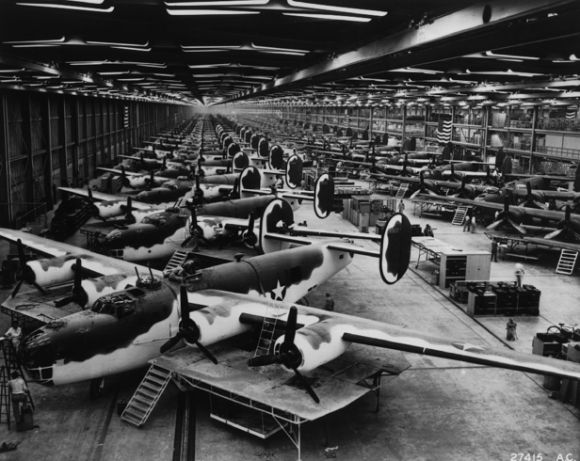
A total of 3,100 B-24Hs were built. By March 1944 Ford were completing one aircraft every 100 minutes and also shipping sub-assemblies to Fort Worth and Tulsa. The Willow Run experiment in mass production was finally paying off.
The Consolidated B-24J Liberator was built in larger numbers than any version of the aircraft, with a total of 6,678 aircraft being built by all five factories involved in the Liberator Production Pool. Originally the B-24J referred to aircraft produced by Consolidated at San Diego and Fort Worth, using modified Consolidated A-6 tail turrets in place of the Emerson turret used on the B-24H. In the spring of 1944 the remaining three factories in the Liberator Production Pool switched over the B-24J, but most of these aircraft used the Emerson turret, while both San Diego and Fort Worth changed over the Emerson turret when enough were available.
Factory
Number produced:
CO – Consolidated, San Diego
2792
CF – Consolidated, Fort Worth
1558
DT – Douglas, Tulsa
205
NT – North American, Dallas
536
FO – Ford Motor Company, Willow Run
1587
All B-24Js had a number of features in common. They were all powered by the R-1830-65 engine, used a new C-1 automatic pilot and a modified M-series bomb sight. However all five factories produced slightly different aircraft, making maintenance very awkward.
B-24J-CO (San Diego)
B-24J production began at the Consolidated factory at San Diego in August 1943. By this point Consolidated had merged with Vultee, and the combined company is normally referred to as Convair.
The B-24J-CO featured the Consolidated A-6 nose turret. In other ways it was less advanced than the B-24H, which had featured a new Martin A-3D “high hat turret” and enclosed staggered waist guns, while the San Diego produced B-24Js retained the earlier lower upper turret and open windows, at least until late in the production run. Eventually enough Emerson turrets were available for them to be used at San Diego, either with the 181st aircraft or with production block 190 (sources vary)
B-24J-CF (Fort Worth)
Production of the B-24J began at Fort Worth in September 1943. As at San Diego the aircraft carried the A-6 nose turret, until either the 41st aircraft or block 45 (sources vary). The B-24J-CF was equipped with the “high hat” turret and staggered and enclosed waist guns.
B-24J-FO (Ford, Willow Run)
Ford at Willow run began production of the B-24J-FO in April 1944. These aircraft also featured the “high hat” turret and staggered and enclosed waist guns.
B-24J-NT (North American, Dallas)
North American at Dallas began production of the B-24J-NT in May 1944. These aircraft also featured the “high hat” turret and staggered and enclosed waist guns.
B-24J-DT (Douglas, Tulsa)
Douglas at Tulsa began production of the B-24J-DT in May 1944. These aircraft also featured the “high hat” turret and staggered and enclosed waist guns.
Statistics (for aircraft with A-6 nose turret)
Wingspan: 110ft
Length: 67ft, 7 5/8in
Empty weight: 36,500lbs
Maximum weight: 65,000lbs
Engine: Four Pratt & Whitney R-1830-65
Horsepower: 1,200 each
Armament: Ten .50 calibre machine guns (two nose, two tail, two dorsal, two ventral and one in each waist position)
Maximum Speed: 290mph
Service Ceiling: 28,000ft
Range: 2,100 miles
The single XB-24K saw the first attempt to fit a single vertical tail to the B-24. The intention was to improve the stability of the aircraft, making it easier and less tiring to fly than the stand twin-tailed design. The XB-24K was produced by modifying a standard B-24D, powered by four 1,350hp R-1830-75 engines. Although the design was a success, it was not adopted for the standard B-24. It would later be used on the naval PB4Y-2 Privateer and would be revived on the XB-24N, which would have become the standard production version of the B-24 if the war had lasted into 1946.
The Consolidated B-24L Liberator was an attempt to improve the performance of the aircraft by reducing its weight. Over recent versions the aircraft had gained ever more equipment, increasing weight and reducing performance. In an attempt to recover some of this lost performance commanders of units in the Pacific had been removing the Sperry ball turret, saving the weight of the turret and its bulky control mechanisms. The same modification was soon made in Europe, where the increasing number of escort fighters reduced the perceived need for the extra turrets.
This modification became a standard feature on the B-24L. Another 200 pounds of weight was saved by replacing the Consolidated A-6B turret of the B-24J with a lighter M-6 “Stinger” tail turret. Combined with other changes, the B-24L was 1,000 pounds lighter than the previous model.
By the summer of 1944 the USAAF had decided that the two factories at San Diego and Willow Run would be able to supply all American requirements for the B-24. By August both plans had switched production to the B-24L, leaving the Consolidated plant at Fort Worth to continue building the B-24J to satisfy British orders. By this point it had been decided to leave the tail turret off completely, allowing the Army Modification Centres to add whatever equipment was required in each theatre. The B-24L thus carried a mix of the M-6A “stinger” turret, the standard A-6B turret and a mounting for two hand held .50 calibre machine guns in an open tail position. A total of 1,667 B-24Ls were built before production moved onto the final version, the B-24M.
The Consolidated B-24M Liberator was the final production version of the aircraft, and was produced by the two remaining Liberator factories – Consolidated at San Diego and Ford at Willow Run. Unlike late production B-24Ls, the B-24M carried a lightweight A-6B turret as standard, with some also carrying a ball turret.
Production began at both plants in December 1944. By the time construction ended in June 1945 Consolidated had built 916 aircraft and Willow Run 1,677. The only significant change during the production run was the introduction of an improved cockpit canopy in block 20, designed to improve visibility.
For a short period the B-24M designation was used to describe 115 late production B-24Ls built by Ford without a tail turret. These aircraft were then re-designated as B-24Ls, matching similar aircraft produced by Consolidated at San Diego.
The Consolidated XB-24N Liberator was a second attempt to fit a single vertical tail to the B-24. A previous effort had produced the single XB-24K, which had proved that the basic idea was correct, but it had not entered production. The single tail had then been adopted by the Navy for the PB4Y-2 Privateer and had produced the hoped-for improvement in stability.
The test program for the XB-24N began in November 1944. As well as the single tail, the new design carried new ball turrets in the nose and tail positions and staggered enclosed waist guns.
The testing program proved the XB-24N to be superior to the B-24J. Seven service test YB-24Ns were built and an order was placed for 5,168 production aircraft. None of these aircraft had been built before the order was cancelled at the end of the war.
The B-24 XB-41.
As the Eighth Air Force began its daylight bombing campaign over Europe it soon discovered that its formations of four engined heavy bombers could not defend themselves against German fighter attack, and losses began to reach unacceptable levels. The eventual solution to the problem was to extend the range of the P-38 Lightning and P-51 Mustang escort fighters, but this would take time.
One alternative that was serious considered was the possibility of creating heavily armed “escort fighters” based on the B-17 Flying Fortress and B-24 Liberator bombers. This approach would have one big advantage – the basic aircraft already existed, and had the range required to accompany the bombers, so if the idea was a success then it would not take too long to produce a large number of these gunships.
The XB-41 was the escort “fighter” based on the B-24 Liberator. It was armed with a total of fourteen .50in machine guns, three to five more than the standard B-24D (which could carry either one or three guns in the nose, two in the waist positions and two each in dorsal, ventral and tail turrets). All fourteen of the guns on the XB-41 were carried in twin gun mountings or turrets. The nose gun or guns were replaced by a twin gun chin turret, similar to the one used on the B-17. A second dorsal turret was added, just behind the wing. Two guns were carried in power boosted mounts in each waist position. The remaining six guns were carried in the standard ventral, dorsal and tail positions. The XB-41 was to carry 12,420 rounds of ammunition. The final aircraft was 6,000lbs heavier than a standard B-24D.
Work on the XB-41 began in the summer of 1942. The completed XB-41 prototype was delivered to the Army Air Force Proving Ground at Eglin Field on 29 January 1943, for the start of two months of trials. On 16 March 1943 the design was approved, a step that would have led to the production of YB-41 service test aircraft, but five days later, on 21 March 1943, the project was cancelled.
This sudden change was triggered by experience with the YB-40, based on the B-17 Flying Fortress. Work on this progress was much more advanced, and a small number of aircraft had actually entered combat over Europe. Two serious problems soon emerged. The first was a technical issue – the heavily loaded YB-40 could keep up with the B-17s on the way out, while they were carrying their bombs, but once the bombers had dropped their bombs, their speed increased, and the heavy YB-40 was unable to keep up. The second problem was that the idea simply did not work. Despite all of the extra weight, all that was achieved was to add a few more guns to the firepower of a bomber formation, and combat experience suggested that these extra guns made little or no difference to the number of losses suffered. The concept of the heavily armed gunship escort “fighter” was abandoned in favour of the conventional escort fighter.
The Consolidated Aircraft Company produced more than 18,400 B-24 Liberators, making it the most produced American wartime aircraft. It gained a distinguished war record with operations in the European, Pacific, African and Middle Eastern theaters. Although its flying characteristics were not as refined as the Boeing B-17 Flying Fortress, it was a more modern design and featured:
| • | A longer range. | |
| • | A higher top speed. | |
| • | A heavier bomb load. | |
| • | Tricycle landing gear. | |
| • | A quantum leap in wing design. |
| In 1938, the United States Army Air Corps (USAAC) sent a request to the Consolidated Aircraft Corporation to become a second source for Boeing B-17s. To honor the request, President Rueben Fleet of Consolidated sent two aides, I. M. Laddon and C. A. Van Dusen to the Boeing factory in Seattle, Washington. After the visit, Rueben Fleet decided that he did not want to produce a design that was already four years old. He wanted to build something more modern and it was about the same time, the USAAC had issued Type Specification 212 for a new bomber with the following requirements: |
| • | 300 mph airspeed. |
| • | 3,000 mile range. |
| • | 35,000 foot ceiling. |
| Instead of building Boeing B17s, Reuben Fleet decided that they would build an entirely new aircraft to meet the new specifications, resulting in the Model 32. The wing of the Model 32 would be virtually identical to the high aspect-ratio Davis wing that had been successfully used on the Model 31 flying boat.1 The Model 32 had a wingspan six feet greater than the B-17, but the wing area was 25% less. The high aspect-ratio wing reduced drag and provided greater fuel efficiency. A contract was awarded in March 1939 and was assigned the military designation XB-24. There was a requirement that the airplane would be ready before the end of the year and Consolidated just met the deadline when the first prototype made its inaugural flight on December 29, 1939. The first flight lasted seventeen minutes.2 The Davis wing demonstrated such remarkable performance on the Model 31 flying boat and early flights of the XB-24 that orders were coming in even before production had started. The USAAC ordered seven YB-24s and twenty B-24As. The first production aircraft were export versions with deliveries beginning in December 1940. The export version was designated as the LB-30 with LB signifying Land Bomber. 120 LB-30s were ordered for France and 164 were ordered by the British.3 Orders for France were not available before its capitulation and the French aircraft were diverted to Britain.4 The top airspeed of the XB-24 was 273 mph and failed to meet the USAAC requirement of 300 mph, but range was the primary concern of the Consolidated team. The engine on the prototype was the Pratt & Whitney R-1830-33 Twin Wasp with a mechanical supercharger. When the engines were upgraded on the XB-24B, to the R-1830-41 with turbo-superchargers, airspeed increased to 310 mph.5 The turbo-supercharger was placed on the lower surface of the engine nacelle and the oil cooler and supercharger ducting were placed on either side of the engine. Looking forward, the right side of the cowl contained the supercharger, generator and oil cooler ducts. The left side contained the intercooler ducts.6 The oval shaped engines would become one of the Liberator's characteristic features. |
The first production Liberators were six LB-30s (ex USAAC YB-24s) and lacked self-sealing fuel tanks. They were used as transatlantic Return Ferry Service airliners with BOAC. This was followed by twenty RAF Liberator Is for Coastal Command as patrol aircraft. The USAAC delayed their order to take delivery on more advanced models.
Although twenty were ordered, only nine B-24As were built as well as nine B-24Cs. The B-24D was the first main production model with 2,728 aircraft produced. The "D", "E" and "G" were essentially the same aircraft, totaling 3,958 aircraft.7
Although some sources credit the North America, Dallas built B-24G-1-NT as having the first nose turret, this distinction actually belongs the first production Ford built B-24H model (c/n 42-7465). The emphasis here is "production" model. Earlier B-24s had nose turrets, but these were installed during field modifications. The nose turret contained two .50 caliber machine guns for frontal protection and increased the B-24 length to 67 feet 2 inches. The Sperry ball turret became standard equipment on the B-24G and following models.
The B-24J was produced in greater numbers than any other series with 6,678 B-24Js built.
The 1,667 B-24Ls and 2,593 B-24M models varied only slightly in armament fixtures from their predecessors.
As production expanded, other manufacturers were requested to participate in production and versions appeared with varying armament and other differences. While the differences may seem slight today, they weren't at the time. Mechanics in the field had to deal with four major variations and four sets of manuals. The B-24 had 1,820 engineering changes or an average 3.6 for every aircraft produced—more than any other WW II aircraft. Construction plants were as follows:
| • | Consolidated - Fort Worth, Texas. |
| • | Consolidated - San Diego, California. |
| • | Douglas - Tulsa, Oklahoma. |
| • | Ford - Willow Run, Michigan. |
| • | North American - Dallas, Texas. |
| By March of 1944, Ford was producing one B-24H every 100 minutes, seven days a week. The supply of aircraft exceeded the USAAF's ability to use them and was becoming a source of embarrassment for the USAAF. |
In Europe, Bomber Command of the Royal Air Force concentrated mainly on night bombing, while the United States Army Air Force operated primarily as a day bombing force. On December 4, 1942, US Liberators of the 9th Air Force attacked Naples, recording their first raid on Italy, followed on July 19, 1943 by the first raid on Rome by 270 Liberators and B-17 Flying Fortresses. The USAAF casualties were among the highest for bombing forces. This was well illustrated on August 17, 1943 when 59 bombers were shot down while attacking German ball-bearing factories, followed by 60 losses in a similar raid in October. In March 1944, a large force of US Liberators and B-17 Flying Fortresses attacked Berlin in daylight, the first of several such raids.
Bomber losses decreased with the perfection of formation flying and the support of long-range escort fighters. Incredibly, Liberators are recorded as having dropped over 630,000 tons of bombs, while several thousand enemy aircraft fell to their guns. Some were converted to carry the first US air-to-surface, radar-guided missile, the Bat, and in April 1945 a Bat sank a Japanese naval destroyer.
Besides the USAAF and RAF, Liberators also found their way into the United States Navy, the Royal Canadian Air Force and the armed forces of other countries. All USN Liberators were designated PB4Y-1s regardless of their USAAF series designation.
Several B-24s were used as transports under the Air Force designation of C-87 Liberator Express and a few became C-109 fuel tankers. After the war, the Liberator continued to serve with the United States forces, notably as an air rescue and weather reconnaissance aircraft with the Coast Guard in the 1950s.
The History Behind the Plane
The 43rd Bombardment Group was created over the winter of 1940-1, on the US East Coast, training with a mix of aircraft. When the United States entered the war in December 1941 the group carried out a number of anti-submarine patrols off the east coast, but it spend most of the war in the South West Pacific with the Fifth Air Force.
The group reached Sydney in March 1942, but did not enter combat until September, when it finally had a reasonable complement of aircraft. From then until November 1944 the group operated in support of the campaign in New Guinea, first from Australia, then from New Guinea and Owi Island, concentrated in particular in attacks on shipping. The unit experimented with low level skip bombing, using this tactic at the battle of the Bismarck Sea, 2-4 March 1943 with some success. The Group received a DUC for its efforts during this battle.
Between May and September 1943 the group's B-17s were replaced with B-24 Liberators, believed to be more suited to the long ranges of many Pacific missions. In November 1944 the group moved to the Philippines, helping the ground campaign on Luzon as well as conducting strategic bombing missions against targets in China and Formosa. Finally in July 1945 it moved to Le Shima, from where it flew missions over Japan, still attacking shipping, as well as airfields and railways.
The Consolidated B-24 Liberator was an American heavy bomber, designed and largely built by the Consolidated Aircraft Company of San Diego, California. It was produced in greater numbers than any other American combat aircraft of World War II, and still holds the record as the most-produced American military or naval aircraft. The B-24 was used every branch of the American armed forces during the war, attaining a distinguished war record with its operations in the Western European, Pacific, Mediterranean, and China-Burma-India Theaters.
Often compared with the better-known B-17 Flying Fortress, the B-24 was a more modern design with a higher top speed, greater range, and a heavier bomb load; however, it was also more difficult to fly, with heavy control forces and poor formation-flying characteristics. Popular opinion among aircrews and general's staffs tended to favor the B-17's rugged qualities above all other considerations in the European Theater.
The placement of the B-24's fuel tanks throughout the upper fuselage and its lightweight construction, designed to increase range and optimize assembly line production, made the aircraft vulnerable to battle damage. The B-24 was notorious among American aircrews for its tendency to catch fire, but it nevertheless provided excellent service in a variety of roles thanks to its large payload and long range.
B-24 Liberator Design & Development:
In 1938, the United State Army Air Corps approached Consolidated Aircraft about producing the new Boeing B-17 bomber under license as part of the "Project A" program to expand American industrial capacity. Visiting the Boeing plant in Seattle, Consolidated president Reuben Fleet assessed the B-17 and decided that a more modern aircraft could be designed using existing technology. Responding in January 1939, Consolidated began designing a new bomber under the USAAC's Specification C-212. This set of specifications called for a bomber with a higher speed and ceiling, as well as a greater range than the B-17.
Assigning the project to chief designer Isaac M. Laddon, Consolidated created a high-wing monoplane that featured a deep fuselage with large bomb-bays, retracting bomb-bay doors, and tricycle landing gear. Powered by four Pratt & Whitney R1830 twin Wasp engines, the new aircraft featured long wings to improve performance at high altitude and increase payload. In addition, the wings possessed other technological improvements such as laminated leading edges. Impressed with the design, the USAAC awarded Consolidated a contract to build a prototype on March 30, 1939.
Dubbed the XB-24, the prototype first flew on December 29, 1939. Pleased with the prototype's performance, the USAAC moved the B-24 into production the following year. A distinctive aircraft, the B-24 featured a twin tail and rudder assembly as well as flat, slab-sided fuselage. This latter characteristic earned it the name "Flying Boxcar" with many of its crews. Like the B-17, the B-24 possessed a wide array of defensive guns mounted in top, nose, tail, and belly turrets. Capable of carrying 8,000 lbs. of bombs, the bomb-bay was divided in two by a narrow catwalk that was universally disliked by air crews.
B-24 Liberator Production:
The initial production batch of B-24As was completed in 1941, with many being sold directly to the Royal Air Force. Sent to Britain, where the bomber was dubbed "Liberator," the RAF soon found that they were unsuitable for combat over Europe as they had insufficient defensive armament and lacked self-sealing fuel tanks. Due to the aircraft's heavy payload and long range, the British converted these aircraft for use in maritime patrols. Learning from these issues, Consolidated improved the design and the first major American production model was the B-24C which also included improved Pratt & Whitney engines.
In 1940, Consolidated again revised the aircraft and produced the B-24D. The first major variant of the Liberator, the B-24D quickly amassed orders for 2,738 aircraft. Overwhelming Consolidated's production capabilities, the aircraft was also built under license by North American, Douglas, and Ford. The latter built a massive plant at Willow Run, Michigan that, at its peak (August 1944), was producing fourteen aircraft per day. Revised and improved several times throughout World War II, the final variant, the B-24M, ended production on May 31, 1945.
In addition to its use as a bomber, the B-24 airframe was also the basis for the C-87 Liberator Express cargo plane and the PB4Y Privateer maritime patrol aircraft. Due to the B-24's range and payload capabilities, it was able to perform well in the maritime role, however the C-87 proved less successful as the aircraft had difficulty landing with heavy loads. As a result, it was phased out as the C-54 Skymaster became available. All told, 18,188 B-24s of all types were built making it the most produced bomber of World War II.
Operational History of the B-24 Liberator:
The Liberator first saw combat action with the RAF in 1941, however due to their unsuitability they were reassigned to RAF Coastal Command. Improved RAF Liberator IIs flew the type's first bombing missions in early 1942, launching from bases in the Middle East. With the US entry into World War II, the B-24 began to see extensive combat service. The first US bombing mission was a failed attack on Wake Island on June 6, 1942. Six days later, a small raid from Egypt was launched against the Ploesti oil fields in Romania.
As US bomber squadrons deployed, the B-24 became the standard American heavy bomber in the Pacific Theater due to its longer range, while a mix of B-17 and B-24 units were sent to Europe. Operating over Europe, the B-24 became one of the principal aircraft employed in the Allies' Combined Bomber Offensive against Germany. Flying as part of the Eighth Air Force in England and the Ninth and Fifteenth Air Forces in the Mediterranean, B-24s repeated pounded targets across Axis-controlled Europe. On August 1, 1943, 178 B-24s launched a famous raid against Ploesti as part of Operation Tidal Wave.
Departing from bases in Africa, the B-24s struck the oil fields but lost 53 aircraft in the process. While many B-24s were hitting targets in Europe, others were playing a key role in winning the Battle of the Atlantic. Flying from bases in Britain and Iceland, VLR (Very Long Range) Liberators played a decisive role in closing the "air gap" in the middle of the Atlantic and defeating the German U-boat threat. During the war, B-24s were credited in the sinking of 72 U-boats. The aircraft also saw extensive maritime service in the Pacific where B-24s and its derivative, the PB4Y-1, wreaked havoc on Japanese shipping.
While a workhorse of the Allied bombing effort, the B-24 was not hugely popular with American air crews who preferred the more rugged B-17. Among the issues with the B-24 was its inability to sustain heavy damage and remain aloft. The wings in particular proved vulnerable to enemy fire and if hit in critical areas could give way completely. It was not uncommon to see a B-24 falling from the sky with its wings folded upwards like a butterfly. Also, the aircraft proved highly susceptible to fires as many of the fuel tanks were mounted in the upper parts of the fuselage. In addition, crews nicknamed the B-24 the "Flying Coffin" as it possessed only one exit which was located near the tail of the aircraft. This made it difficult to impossible for the flight crew to escape a crippled B-24.
It was due to these issues and the emergence of the Boeing B-29 Superfortress in 1944, that the B-24 Liberator was retired as a bomber at the end of hostilities. The PB4Y-2 Privateer remained in service with the US Navy until 1952 and with the US Coast Guard until 1958. The aircraft was also used in aerial firefighting through 2002 when a crash led to all remaining Privateers being grounded.
CONSOLIDATED B-24D LIBERATOR
The Consolidated B-24D was the first Liberator model to enter large scale production -- 2,698 were ordered in 1940-1942. The B-24D was essentially a B-24C with improved engines and some minor production differences. The first 20 D models built were from a block initially ordered as B-24A (40-2349 to 40-2368).
Initially, the B-24D was armed with eight .50-cal. machine guns: the A-6 tail turret, Martin top turret, and one each at the nose (some aircraft had two nose guns positions), waist (left and right) and tunnel positions. The tunnel gun (lower aft fuselage) was replaced by a remote-controlled Bendix belly turret, and it was soon replaced by a Sperry ball turret. The single nose gun was augmented by left and right cheek mounted guns for late model B-24Ds.
TECHNICAL NOTES:
Armament: 11 .50-cal. and 8,000 lbs. of bombs (eight or nine .50-cal. machine guns on early models)
Engines: Four Pratt & Whitney R-1830-43 supercharged radials of 1,200 hp each (takeoff power)
Maximum speed: 303 mph
Cruising speed: 200 mph
Range: 4,600 miles (max ferry range); 2,850 miles with 5,000 lbs. bomb load
Service ceiling: 32,000 ft.
Span: 110 ft. 0 in.
Length: 64 ft. 4 in.
Height: 17 ft. 11 in.
Weight: 56,000 lbs. loaded
The B-24 was employed in operations in every combat theater during World War II. Because of its great range, it was particularly suited for such missions as the famous raid from North Africa against the oil industry at Ploesti, Rumania, on Aug. 1, 1943. This feature also made the airplane suitable for long over-water missions in the Pacific Theater. More than 18,000 Liberators were produced.
The B-24D on display flew combat missions from North Africa in 1943-1944 with the 512th Bomb Squadron. It was flown to the museum in May 1959. It is the same type airplane as the "Lady Be Good" -- the world-famous B-24D that disappeared on a mission from North Africa in April 1943 and was found in the Libyan Desert in May 1959.
Consolidated B-24 Liberator Variations
- Liberator 11 (LB-30). Had no B-24 counterpart (LT3-30 designation signifies Liberator built to British specifications). Four Pratt & Whitney R-1830-S3C4G engines with two speed superchargers and driving Curtiss Electric full-feathering propellers. Armed with eleven .303 in. guns, eight in two Boulton Paul power turrets, one dorsal and one tail, one in the nose and two in waist positions.
- XB-24B. The first B-24 to be fitted with turbo-supercharged engines, self-sealing tanks, armor, and other modern refinements.
- B-24C. Four Pratt & Whitney R-1830-41 engines with exhaust-driven turbo-superchargers. Armament augmented to include two power-driven turrets, one dorsal and one tail, each fitted with two .50-cal. guns. In addition, there was one .50-cal. nose gun and two similar guns in waist positions.
- B-24D (PB4Y-l and Liberator B.III and G.R.V.). Four Pratt & Whitney R-1830-43 engines. Armament further increased by the addition of two further nose guns and one tunnel gun, making a total of ten .50-cal. guns. Fuel capacity increased by the addition of auxiliary self-sealing fuel cells in the outer wings and there was provision for long-range tanks in the bomb-bay. The first model to be equipped to carry two 4,000 lb. bombs on external racks, one under each inner wing. The Liberator G.R.V. was used as a long-range general reconnaissance type by RAF Coastal Command. Fuel capacity was increased at the expense of amour and tank protection. Armament consisted of one .303-in. or .50-cal. gun in the nose, two .50-cal. guns in the upper turret, four .303 -in. or two .50-cal. guns in waist positions and four .303-in. guns in a Boulton Paul tail turret. Bombs or depth charges 5,400 lbs.
- B-24E (Liberator IV). Similar to B-24D except for minor equipment details. Built by Consolidated (Forth Worth), Ford (Willow Run) and Douglas (Tulsa).
- B-24F. An experimental version of the B-24E fitted with exhaust-heated surface anti-icing equipment on wings and tail surfaces.
- B-24G, B-24H and B-24J (PB4Y-l and Liberator B.VI and G.R.VI). Similar except for details of equipment and minor differences associated with different manufacturing methods. B-24J built by North American (Dallas). B-24H built by Consolidated (Forth Worth), Ford (Willow Run) andDouglas (Tulsa). B-24J built by Consolidated (San Diego and Fort Worth), Ford, Douglas and North American (Dallas). Four Pratt & Whitney R-1830-43 or 65 engines. Armament further improved to include four two-gun turrets, in nose and tail and above and below the fuselage (details below). Later models of the B-24J were fitted with exhaust-heated anti-icing equipment. The Liberator G.R.VI was used as a long-range general reconnaissance type by RAF Coastal Command. Armament consisted of six .50-cal. guns, two each in nose and dorsal turrets and in waist positions, and four .303-in. guns in a Boulton Paul tail turret. Bombs or depth charges 4,500 lbs. (2,045 kg.).
- XB-24K. The first Liberator to be fitted with a single fin and rudder. An experimental model only.
- B-24L. Similar to the B-24J but fitted with a new tail turret with two manually-operated .50-cal. guns. The two guns had a wider field of fire and the new turret, which was designed by the Consolidated Vultee Modification Center at Tucson permitted a saving of 200 lbs. (91 kg.) in weight.
- B-24M. Same as the B-24L except fitted with a new Motor Products two-gun power-operated tail turret. A B-24M was the 6,725th and last Liberator built by Consolidated Vultee at San Diego.
- B-24N. The first production single-tail Liberator. Fitted with new nose and tail gun mountings. Only a few were built before the Liberator was withdrawn from production on May 31,1945.
- CB-24. Numbers of B-24 bombers withdrawn from operational flying in the European Theater of Operations were stripped of all armament and adapted to various duties, including utility transport, etc. Painted in distinctive colors and patterns, they were also used as Group Identity Aircraft to facilitate the assembly of large numbers of bombers into their battle formations through and above overcast weather. All these carried the designation CB-24.
- TB-24 (formerly AT-22). A conversion of the B-24D for specialized advanced training duties. All bombing equipment and armament removed and six stations provided in the fuselage for the instruction of air engineers in powerplant operation, essentially for such aircraft as the Boeing B-29 and the Consolidated Vultee B-32, which are the first large combat aircraft in the USAAF to have separate completely equipped engineer's stations.
- C-109. A conversion of the B-24 into a fuel-carrying aircraft. The first version, modified by the USAAF had metal tanks in the nose, above the bomb-bay and in the bomb-bay holding a total of 2,900 US gallons. Standard fuel transfer system for loading and unloading through single hose union in side of fuselage. Inert gas injected into tanks as fuel pumped out to eliminate danger of explosion. Developed for transporting fuel from India to China to supply the needs of the B-29s operating therefrom. Later version modified by the Glenn L. Martin Company, fitted with collapsible Mareng fuel cells.
| Specifications: | ||||
|---|---|---|---|---|
| Consolidated B-24 Liberator | XB-24 | B-24C | B-24G | B-24J |
| Dimensions: | ||||
| Wing span: | 110 ft 0 in (33.53 m) | 110 ft 0 in (33.53 m) | 110 ft 0 in (33.53 m) | 110 ft 0 in (33.53 m) |
| Length: | 63 ft 9 in (19.43 m) | 63 ft 9 in (19.43 m) | 67 ft 2 in (20.47 m) | 67 ft 2 in (20.47 m) |
| Height: | 18 ft 8 in (5.68 m) | 18 ft 8 in (5.68 m) | 18 ft 0 in (5.49 m) | 18 ft 0 in (5.49 m) |
| Weights: | ||||
| Empty: | 27,500 lb. (12,473 kg) | 32,050 lb. (14,573 kg) | 38,000 lb. (17,236 kg) | 38,000 lb. (17,236 kg) |
| Combat: | 38,360 lb (17,399 kg) | 41,000 lb (18,597 kg) | 56,000 lb (25,401 kg) | 56,000 lb (25,401 kg) |
| Maximum: | 46,100 lb (20,910 kg) | 56,000 lb (25,401 kg) | 71,200 lb (32,295 kg) | 71,200 lb (32,295 kg) |
| Performance: | ||||
| Maximum Speed: | 273 mph (439 km/h) @ 15,000 ft (4,572 m) | 313 mph (503 km/h) @ 25,000 ft (7,620 m) | 290 mph (467 km/h) @ 25,000 ft (7,620 m) | 290 mph (467 km/h) @ 25,000 ft (7,620 m) |
| Service Ceiling: | 31,500 ft. (9,601 m) | 34,000 ft. (10,363 m) | 28,000 ft. (8,534 m) | 28,000 ft. (8,534 m) |
| Combat Range: | 2,850 miles (4,586 km) w/2,500 lb. (1,133 kg) | 2,100 miles (3,379 km) w/5,000 lb. (2,267 kg) | 1,700 miles (2,735 km) w/5,000 lb. (2,267 kg) | 1,700 miles (2,735 km) w/5,000 lb. (2,267 kg) |
| Ferry Range: | 4,700 miles (7,563 km) | 3,560 miles (5,729 km) | 3,300 miles (5,310 km) | 3,300 miles (5,310 km) |
| Powerplant: | Four 1,200 hp Pratt & Whitney R-1830-33. | Four 1,200 hp Pratt & Whitney R-1830-41. | Four 1,200 hp Pratt & Whitney R-1830-65. | Four 1,200 hp Pratt & Whitney R-1830-65. |
| Armament: | Six .30-caliber guns, one in nose, dorsal, tail hatch and each waist position. Internal bomb load of 8,800 lbs. (3,991 kg). | Six .30-caliber guns, one in nose, dorsal, tail hatch and each waist position. Internal bomb load of 8,800 lbs. (3,991 kg). | Ten .50-caliber guns, two each in nose & dorsal turret and waist positions. Sperry ball turret and MPC A-6B tail turret. Total bomb load 12,800 lbs. (5,805 kg) with optional external bomb racks. | Ten .50-caliber guns, two each in nose & dorsal turret and waist positions. Sperry ball turret and MPC A-6B tail turret. Internal bomb load 8,000 lbs. (3,632 kg). |
