3/18/1943
A voluntary Mission
A very well known fellow of the famous B-24 "Roarin' Rosie" - Curries Crew, named Ray W. Smeltzer, responded to this website in 2001 with some information that has given me some information to help me build this site. Ray has since passed away.
I thank him for taking the time to give me his contribution. RIP Ray, you were truly a credit to our nation and a hero. The text of his email is below.
Jack,
I knew your father, Staff Sergeant John Demcovich as well as any serviceman could know another. He was a hero and gave our great country his all every day. I am very familiar with the mission he flew that day 3/18/1943 aboard the B-24 named "One Time". The name was fitting as our Command knew the mission was almost impossible to accomplish and they suspected the aircraft would not make it back. However, it did, barely.
This was a voluntary mission, the odds were against you coming back. They were sent out to get some very critical information regarding the enemy's defenses for a planned attack the following day. The mission was special because the plane was stripped of it's normal guns and bombs, with just enough fuel to get there and back, to lose weight as they had to fly high. There was nothing aboard it except a few cameras and video recorders and a couple .50 caliber machine guns. No craft lighting, they flew completely dark. They were discovered after getting the required information back to Command HQ and were attacked by enemy Zeros. They shot down 2 Zeros with the .50 cal. guns they had aboard and kept the others at bay until they were back to base. They did crash land the plane as it was shot up real bad and the plane was scrapped after this "One Time" critical mission.
Mission accomplished!
Ray W. Smeltzer, Radio Operator-Gunner Technical Sergeant (T/Sgt).
Roarin' Rosie - Curries Crew
319th Bombardment Squadron
90th Bombardment Group
Returned to the States July 1943
A little bit about Ray Smeltzer...
The crew of Aircraft number 41-23698 'Roarin Rosie' included Lieutenant Alden Currie (pilot), Technical Sergeant (T/Sgt). Ray Smeltzer (radio operator-gunner); Second Lieutenant (2nd Lt) Nicholas J Hnatyk; Staff Sergeant (S/Sgt) George Rice; 2nd Lt James H Case; Sgt Dennard J Bailey; 2nd Lt Richard A Adams; T/Sgt William J Maurizio and S/Sgt Kenneth R Strait. This crew were officially credited with shooting down seventeen Japanese fighter aircraft, more than any other USAAF bomber in the Pacific theatre.
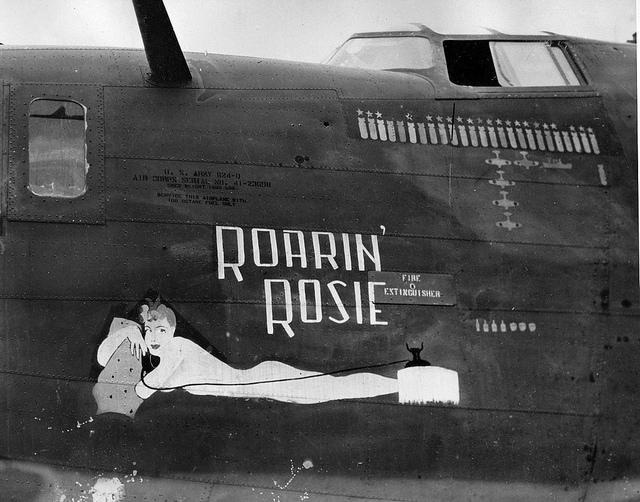
Roarin’ Rosie
This is a e-mail Ray Smeltzer sent to me talking about one of his missions...
We were credited with 4 confirmed, 3 probables. All I know, is I counted 15 fighters, some of the gunners counted 12.. very difficult to count them during a fight like that. There were 5 left when we were done. Our nose gunner, Ken Strait, was pretty badly hit, I think he had a bullet in almost every joint on the left side of his body.. While the fight was very rough and mean, the tension did not decrease after the fighters left. It took us several hours to climb to 800 Ft. from 200.. Keep in mind that on a lone recon the B-24 had little or no protection from the bottom. So, we headed for the deck, and then they couldn't get under us to wipe us out. When we hit the coast of Australia, we couldn't find Darwin.. I was on the radio almost constantly talking to the base, but it was dusk and we couldn't see any lights.. First I asked them to turn on the runway lights, and when they said they were on, I asked them to have searchlights turned on and aimed straight up so the light would bounce off the clouds.. As we were preparing to bail out, one of the crew let out a yell over the intercom and said "I see the lights ".. I then asked the Ground Station to have Ambulance and Crash Crew standing by. When we were on final, the pilot said I am lowering the gear.. since we had been having fires aboard from leaking hydraulic fluid, we were worried about that, but the gear came down and then we hit the runway and suddenly the pilot yelled " The brakes are gone ".. and everybody braced themselves.. Bert Jordan was preparing to start the Auxillary Generator right below the flight deck, I reached down and got him by the shirt collar and pulled him up on the flight deck - pretty crowded there. When we reached the end of the runway, Currie tried to maneuver the ship down a road that took us away from the fuel dump and we hit trees until the right gear went and swung us around to a violent stop. We on the flight deck went out the top hatch; several men threw Strait up through the hatch to 2 more standing on top, and then the bombardier hurried him off the wing leading edge to the ground. When I got on top I saw they were moving slow, so I jumped off the high side and started to run. We were all afraid that the ship would blow up.. but she didn't .. I talked to an Aussie who had helped drain the tanks, and he said we had 8 gallons in one tank and less than 5 in the others.. The only injury due to the crash, the photographer, cut his finger.. Lucky.. you bet!!
The Best Damn Heavy Bomb Group was not attached to the 90th Bomb Group without reason. For one, the 90th shot down more enemy planes than any other bomb group in the Fifth Air Force, 408.
The 319th Squadron led the group with 122 confirmed enemy planes downed. Leading the 319th was the Alden Currie crew. Currie’s crew were credited with downing 16 enemy planes.
An example of this crew’s missions is a photo recon of Ambon Harbor on March 18, 1943. As they approached the harbor they observed 9 or 10 enemy aircraft over the harbor. They maneuvered to permit the photographer to obtain excellent oblique views of the harbor and the shipping within. When the photos were taken and a course set for home the Zeros realized an attack on the harbor was not going to happen so they attacked. Initially they dropped aerial bombs which were evaded by Lt. Currie. The Zeros then proceeded to attack from all angles, pressing each pass closely and tenaciously. For one hour and twenty-five minutes they made pass after pass. Four Zeros were shot down by crew members Kenneth Strait, Bert Jordan, George Rice, and Dennard Bailey, with two others probably shot down and one damaged.
One of the starboard engines was shot out early in the engagement, the hydraulic system was also shot out with two trim tab cables and pulleys broken and an elevator cable damaged from enemy fire. Several small fires were started in the tail turret but they were extinguished. The nose gunner was wounded and the bombardier, James Case, took over the one nose gun that remained operational. Six of the planes eleven guns, including the tail turret guns, were out of action. Combat was broken off when Lt. Currie was able to climb into cloud cover. Currie displayed extreme skill as a pilot flying their severely damaged plane which on the flight home could not climb about 800 feet and was pierced by 300 machine gun and cannon shell holes. At Darwin he crash landed the plane with no other injury to the crew except for a small cut on the photographer’s hand. The plane never flew again.
This mission was not an exception for this crew or the squadron. Previously, on another mission to Ambon on February 6, 1943, Rice, Bailey, Strait, and this time Ray Smeltzer, shot down four planes. George Rice was a squadron ace having shot down five enemy planes. Just behind the Currie crew was that of Roy Olsen. Olsen’s crew shot down 15 enemy planes downing four on a mission to Ambon and three planes twice on missions to Bima and Wewak. The 319th’s second ace, William Simon, was a member of the Olsen crew. The Olsen crew was lost on June 23, 1943, when an enemy fighter collided with their plane severing the wing.
Alden Currie was quoted in a hometown paper saying, “Liberators are in no particular danger from Zeros when there are three or more ships in your group.” Unfortunately single missions were common. James Case, Currie’s bombardier and last surviving member of the crew, passed away on January 29, 2009.
Truly they were the best of the best.
