The Four-Stroke
Five-Event-Cycle Principle


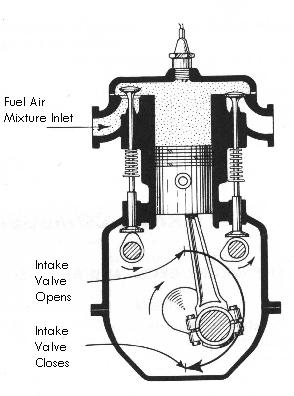
The Intake or Admission Stroke
    During the intake or admission stroke, the piston moves downward as a charge of combustible fuel and air is admitted into the cylinder through the open intake valve. At the completion of this stroke the intake valve closes. This is event No. 1.

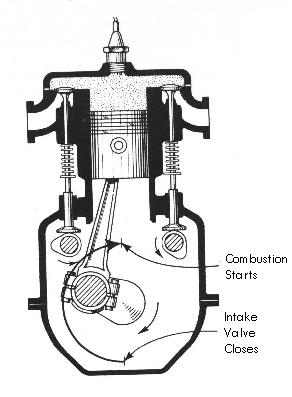
The Compression Stroke
    During the compression stroke, the crankshaft continues to rotate, the piston is forced upward in the cylinder, and both intake and exhaust valves are closed. The movement of the piston upward compresses the fuel-air mixture. This is event No. 2.

Power or Expansion Stroke

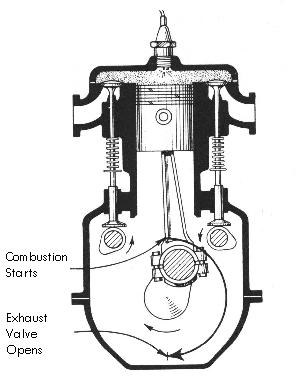
    As the piston approaches the top of its stroke within the cylinder, an electric spark jumps across the points of the spark plugs and ignites the compressed fuel-air mixture. This is the ignition event, or event No. 3. The intake and exhaust valves are closed.

    Having been ignited, the fuel-air mixture burns. It expands as it burns and drives the piston downward. This causes the crankshaft to revolve. Since it is the only stroke and event that furnishes power to the crankshaft, it is usually called the power stroke, although it is sometimes called the expansion stroke for purposes of instruction. This is event No. 4. The intake and exhaust valves are closed.


The Exhaust or Scavenging Stroke

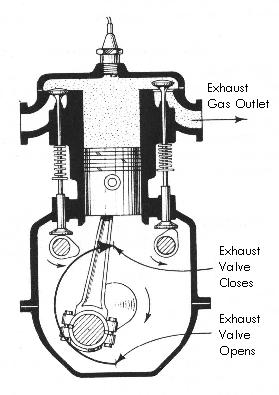
    During the power or expansion stroke, the hot gases obtained by combustion exert tremendous pressure on the piston to force it to move downward, but near the end of the stroke this pressure is greatly reduced because of the expansion of the gases. At this stage, the exhaust valve opens as the crankshaft continues to revolve and the piston is again moved upward in the cylinder by the connecting rod. The burning gases remaining in the cylinder are forced out through the exhaust valve, hence this stroke is usually called the exhaust stroke, although it may be called the scavenging stroke for purposes of instruction. This is event No. 5. One engine cycle has been completed.


Summary of Events

    To summarize the events, it is found that the charge of fuel and air was admitted into the cylinder during the intake stroke (event No. 1); the piston compressed the fuel-air mixture during the compression stroke (event No. 2); the electric spark ignited the compressed fuel-air mixture as the piston approached the top of its stroke within the cylinder (event No. 3); the fuel-air mixture burned and the expanding gases drove the piston downward during the power stroke (event No. 4); the burned gasses were forced out of the cylinder during the exhaust stroke (event No. 5)."

    This five-event sequence of intake, compression, ignition, power, and exhaust, is a cycle which must take place in the order given if the engine is to operate at all, and it must be repeated over and over for the engine to continue operation.

    None of the five events can be omitted, and each event must take place in the proper sequence. For example, if the gasoline supply is shut off, there can be no power event, but the mixture of gasoline and air must be admitted to the cylinder during the intake stroke. Likewise, if the ignition switch is turned off, there can be no power event. Ignition must occur before the power stroke can take place.


Master-and-articulating-rod Assembly
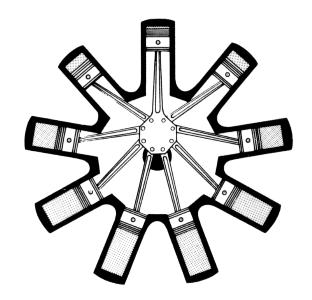
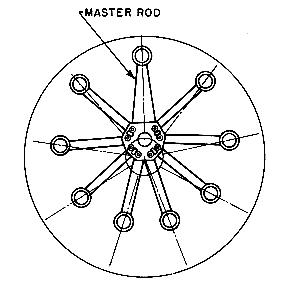
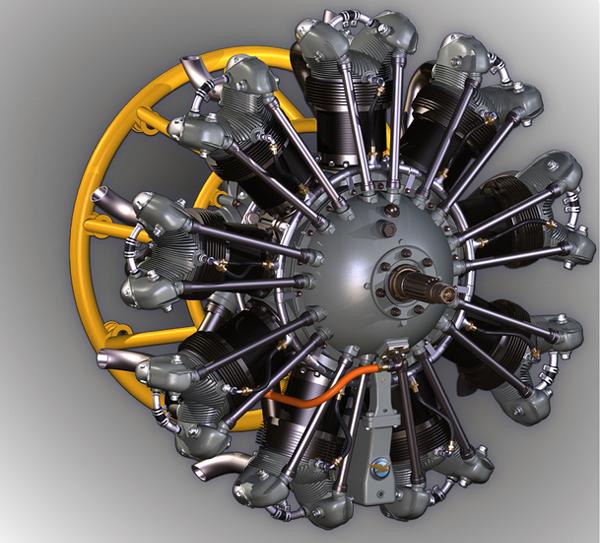
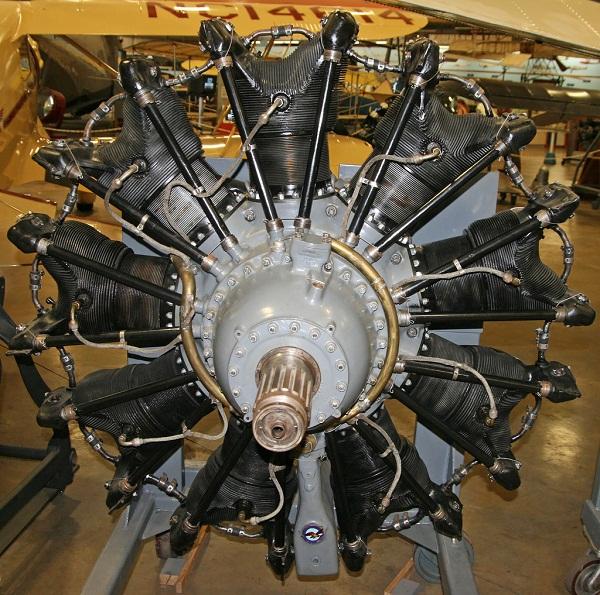
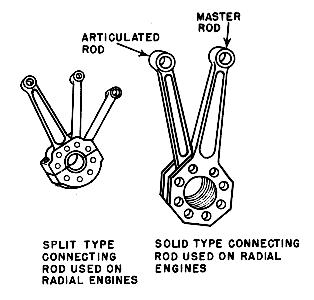
    The master-and-articulating-rod assembly is used on X-type engines, radial-type engines, and on some V-type engines. The master rod is similar to any other connecting rod except that it is constructed to provide for the attachment of the articulated rods on the big end.

    The articulated rods are fastened by knuckle pins to a flange around the master rod. Each articulated connecting rod has a bushing of nonferrous metal, usually bronze, pressed or shrunk into place to serve as a knuckle-pin bearing. The knuckle pins may be held tightly in the master-rod holes by press fit and lock plates or they may be of the full-floating type.

    If the big end of the master rod is made of two pieces, the cap and the rod, then the crankshaft is made of one solid piece. On the other hand, if the rod is made of one piece, then the crankshaft may be of either two-piece or three-piece construction. Regardless of the type of construction, the usual bearing surfaces must be supplied.

    It should be understood that the type of connecting rod used in an engine depends largely on the cylinder arrangement. If the cylinders are arranged in a line parallel to the crankshaft, the connecting rod is similar to that used in most automobile engines. However, certain types of aircraft engines have a system of connecting rods connected to the same crankshaft bearing, called an articulating connecting-rod assembly. The main rod or master rod joins one of the pistons with the crankshaft, and the other rods, called articulating rods or link rods, connect the other pistons to this same master connecting rod.
 

The Lycoming XR-7755 was the largest reciprocating ever built. 


 It produced 5,000
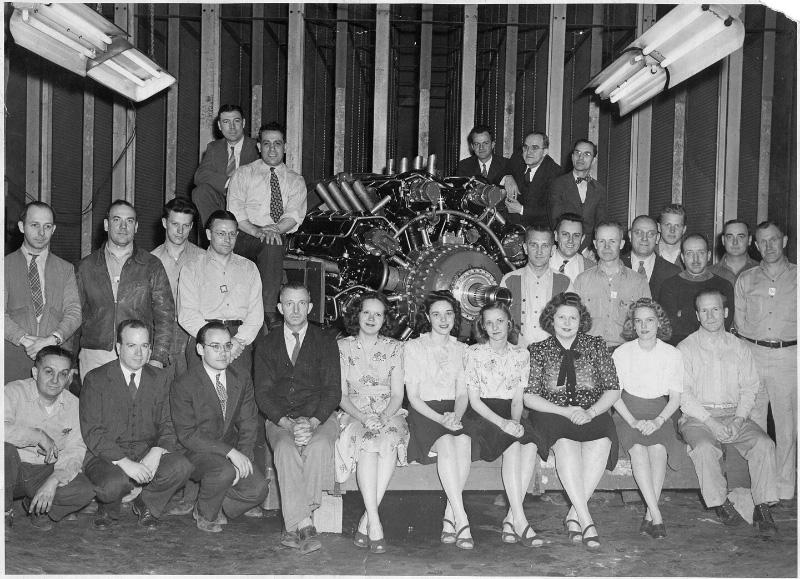
    XR-7755 ENGINEERING TEAM are shown with their "baby", the giant 36 cylinder engine. Left to right in the front row are; Boris Osojnak, Tom Kennedy, Otto Shuey, Sam Fry, Robert McElhanny and Don Little. In the second row are Jack Carpenter, John Guibord, Clarence Wiegman, Charlotte Plankenhorn, Roscoe Kendig, Robert Dittmar and Paul M. McBride. In the third row are Hess Wertz, George Love, Bernard Shew, Edgar Demmien, Frank Murray, Leo Aldrich, Fred Jones, Waldo Bird and Jim McRoberts. HP at 2,600 RPM.


    The XR-7755, 36-cylinder engine was destined to be the largest reciprocating engine ever built. The displacement was 7,755 cubic inches. When compared to Lycoming's largest production engine in production today which displaces 720 cubic inches, it was more than 10 times larger!

    The huge engine was 10 feet long, 5 feet in diameter and weighed 6,050 pounds. It produced 5,000 hp at 2,600 rpm, and the target was 7,000 hp. It used 580 gph of aviation gas at the 5,000 hp rating.

    There were nine overhead camshafts which could be shifted axially for METO power in one position and cruise at the other. Two great shafts emerged for coaxial propellers, and there was a two speed gear-change box between the crankshaft and the propeller shafts.

    Development of the XR-7755 began at Lycoming in Williamsport in the summer of 1943. With the end of World War II in 1945, the military no longer had a need for an engine of this size, and development of the XR-7755 stopped at the prototype stage.

    During those years, Lycoming put together a team, under the leadership of VP Engineering Clarence Wiegman, to develop this super-size engine.

    The engine now resides at Silver Hill of the Smithsonian Institute.

     The Pratt & Whitney R-1830 Twin Wasp was a 14 cylinder, double-row, air-cooled radial engine. Horsepower ranged from 800 hp to 1,350 hp depending on the model and configuration. More than 173,600 engines were produced and it was used in a range of aircraft that included the Douglas DC-3 DST ( Douglas DC-3 DST ), B-24 Liberator ( B-24 Liberator ), Grumman F4f Wildcat ( Grumman F4F Wilcat ) and Curtiss P-36. ( Curtiss P-36 ).

   
    Development began in 1929 when Pratt & Whitney first began its double-row engine experimentation. The advantages of the double-row power plant for aircraft was a larger displacement with no increase in frontal area. Smaller cylinders could be used which permitted greater crank speeds creating smoother operation. The smaller, more frequent power impulses further contributed to smoothness and longer engine life.1
   
Production began in 1932 and design features included:
   
Increased fuel efficiency.
Automatic mixture control.
Automatic valve gear lubrication.
Patented pressure baffles for increased cooling.
   
    Pratt & Whitney saw the need at the time for the future requirements for both military and commercial service for more horsepower and foresaw the two-row type had possibilities for future development. Company engineers continued working on the development of larger models leading to the production of the R-2800 Double Wasp ( R-2800 Double Wasp ).

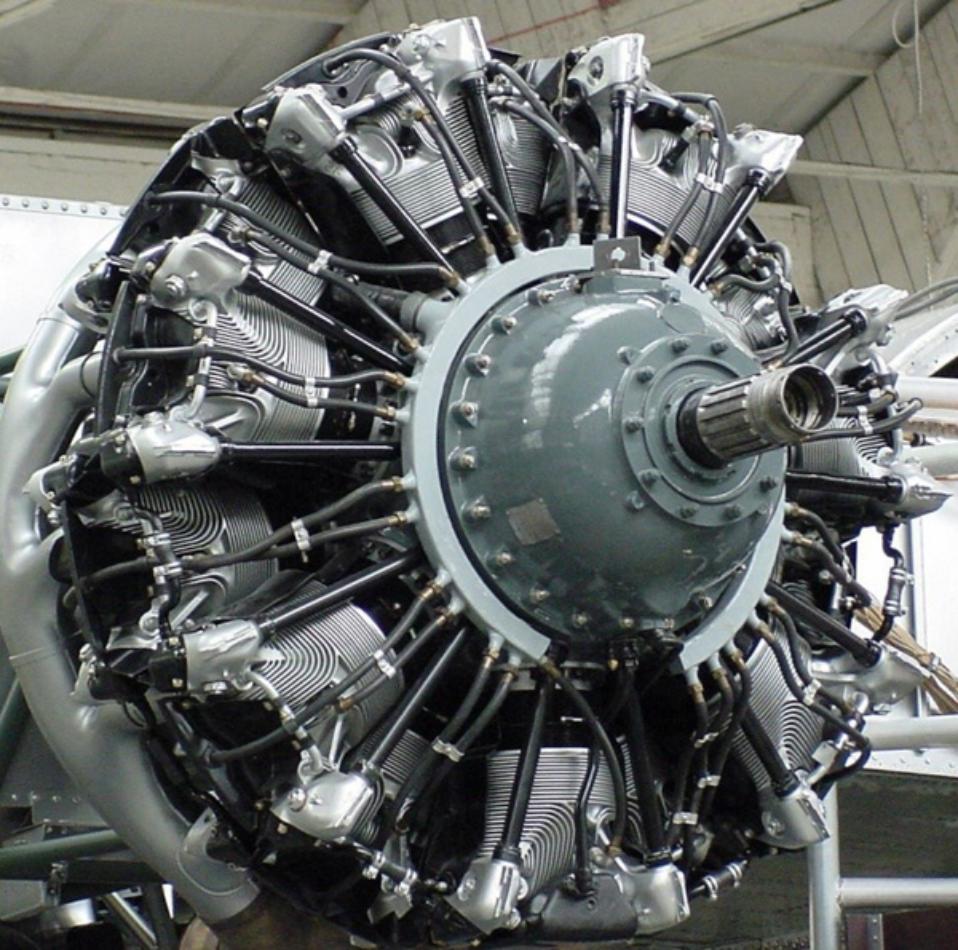
    The Pratt & Whitney R-985 Wasp Junior was a 9 cylinder, single-row, air-cooled radial engine with horsepower ranging from 300 hp to 450 hp, depending on the model and configuration. It was used in a range of aircraft that included the Grumman Goose, Lockheed Model 10A and Beechcraft Model 18. Jacqueline Cochran used the Wasp Junior to set speed and altitude records in a specially built D17W Beechcraft Staggerwing.

    In the mid 1930s, Pratt & Whitney produced five basic engines:
   
The single-row   Wasp Junior.
The single-row   Wasp. 
The single-row   Hornet. 
The double-row Twin Wasp. 
The double-row Twin Wasp Junior.
    The Wasp Junior was smaller version of the R-1340 Wasp designed to compete in the market for medium-sized aircraft engines. Development was completed in 1929 and the engine went into production in early 1930 at the new 400,000 sq/ft Pratt & Whitney plant that opened on January 1, 1930 in East Hartford.1 The original Wasp Junior was rated at 300 hp at 2,000 rpm and and was similar in power and displacement to the J-6-9 Whirlwind. A supercharged version developed 400 hp at 2,300 rpm at 4,000 ft. and by 1932 power was up to 420 hp with racing versions greater than that.2
    In 1931, Pratt & Whitney developed a “hot spot” or heat exchanger on the oil regulator to improve engine performance. It was installed between the carburetor and the rear section of the engine. The regulator used the temperature drop of the gasoline evaporation to cool the oil and the same unit used the engine exhaust to heat the fuel/air mixture in cold weather.


The Pratt & Whitney R-1690 Hornet.

In the mid 1930s, Pratt & Whitney produced five basic engines:

   
The single-row  Wasp Junior.
The single-row   Wasp.
The single-row   Hornet.
The double-row Twin Wasp. 
The double-row Twin Wasp Junior.
   
    The Pratt & Whitney Hornet was a 9 cylinder, single-row, air-cooled radial engine. Horsepower ranged from 525 hp to 1,050 hp depending on the model and configuration. It was produced in two ranges:
   
The R-1690 Hornet A.
The R-1860 Hornet B.
   
    The series began with the R-1690 Hornet A in 1926 following production of the air-cooled R-1340 Wasp. It was enlarged in 1929 as the R-1860 Hornet B, but it was not a commercial success. The Hornet competed with its own Pratt & Whitney     R-1830 Twin Wasp and the Wright Cyclone R-1820. Even though the Hornet was cheaper and simpler than the Twin Wasp, the Twin Wasp was a much more powerful engine and the Hornet's larger diameter was its main drawback. In the end, the Twin Wasp became a more sought after engine and the Hornet was dropped from production. 

    Production was a modest 2,944 engines produced from 1926 to 1942 and it was used in a range of aircraft that included the Boeing B-9 and Boeing Model 299. By 1934, the Sikorsky S-42 was using four Hornets rated at 750 hp each.2 The Hornet was also built under license in Italy as the Fiat A.59 and in Germany as the BMW 132 which powered the Junkers Ju-52.


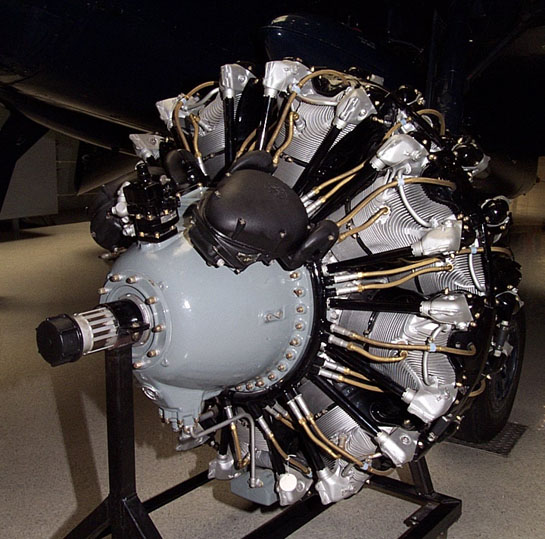
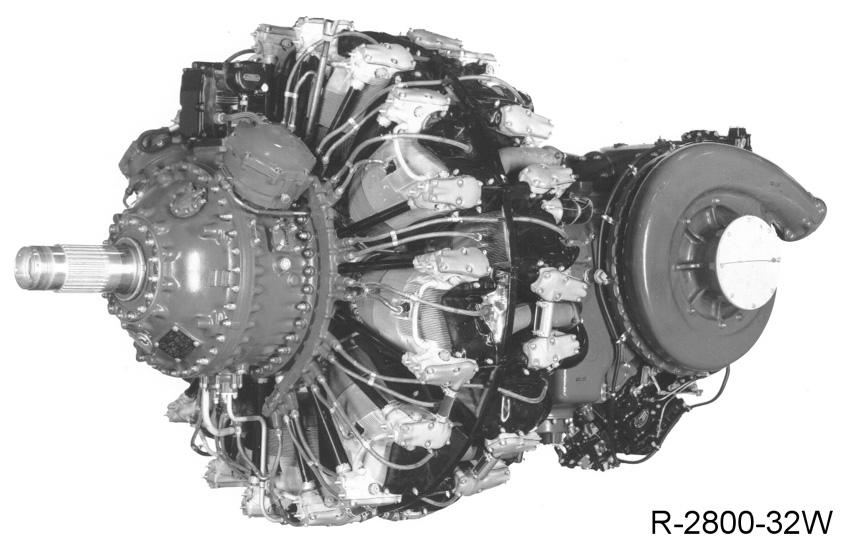
    Pratt and Whitney's R-2800 (46 L) Double Wasp was America's first 18 cylinder radial engine. Although much smaller than the world's only other modern eighteen cylinder engine, the 3,442 cu in. (56.4 L) Gnome-Rhone 18L, it was nevertheless more powerful. While the Gnome-Rhône 18L produced only 1,300 hp (970 kW), the R-2800 averaged 2,000 hp (1,490 kW). By 1950, the engine was able to produce 2,400 hp (1,790 kW) and with water injection as high as 3,400 hp (2,535 kW) for emergency combat conditions.1
    Heat dissipation was correspondingly more of a problem and this meant that for the R-2800, the cast or forged cooling fins that had served so well in the past had to be discarded. The cooling fins needed were so thin and fine-pitched that they had to be machined from the solid metal of the head forging. All the fins were cut together. A gang of milling saws was automatically guided as it fed across the head so that the bottom of the grooves rose and fell to make the roots of the fins follow the contour of the head. The results were worth the trouble as it was a case of designing an engine component that could only be made by a new method and then keeping everything crossed until the new method proved to be practical. In addition to the new head design, the Double Wasp had probably the most scientific baffling yet to direct the flow of cooling air, more so even than the excellent arrangements on the Ranger inline air-cooled engines.


    2,000 hp (1,490 kW) was obtained from the R-2800 with 1 hp/1.4 cu in. (43.6 hp/L) of displacement. In 1939, when the R-2800 was introduced, no other air-cooled engine came close to this figure, and even liquid-cooled ones barely matched it. The designing of conventional air-cooled radial engines had become so scientific and systematic by 1939 that the Double Wasp was introduced at a power rating that was not amenable to anything like the developmental power increases that had been common with earlier engines. It went to 2,100 hp (1,565 kW) in 1941 and to 2,400 hp (1,790 kW) late in the war, but that was all for production models. Experimental models, as always, were coaxed into giving more power, one fan-cooled subtype producing 2,800 hp (2,090 kW), and considerably more (up to 3,600 hp (2,685 kW)) on dynamometers. Technicians at the Republic Aircraft Corporation ran the engine at extreme boost pressures at 3,600 hp (2,685 kW) for 250 hours without any failure using common 100 octane avgas, but in general, the R-2800 was a rather fully developed powerplant right from the beginning.

    It was exclusively a powerplant for fighters and medium bombers during the war, being used in the Republic P-47 Thunderbolt ( Republic P-47 Thunderbolt ), the  Grumman F6F Hellcat ( Grumman F6F Hellcat ) and the  Vought F4U Corsair ( Vought F4U Corsair ), and also in the Martin B-26 Marauder ( Martin B-26 Marauder ) and Douglas A-26 Invader twin engine mediums. Post-war its reliability commended its use for long-range patrol planes and for the Douglas DC-6, Martin 404, and Convair transports. This last application is noteworthy, since these were twin-engine craft of size, passenger capacity, and high wing loading comparable with the DC-4 and the first Lockheed Constellations.  ( Lockheed Constellations ). 

    Two engines were all right for transports as with the Douglas DC-3's moderate wing loading, and the high wing loading of the Douglas DC-4 was safe enough when there were four engines, but all that weight with only two engines seemed like tempting fate. However, the Convair engineers knew what they were doing. (Those at Martin, and those who tested the Martin for government approval didn't—the Martin's wings failed from fatigue after a while.) The Convairs were just as good in their way as the four-engine transports. A well engineered installation and good controls were probably what made the difference.

    When the USA went to war in December 1941, there were very quickly some major changes in philosophy. Such long-established engines as the Cyclone and Twin Wasp were re-rated on fuel of much higher anti-knock value to give considerably more power. Perhaps the most outstanding example was the great R-2800 Double Wasp, which went into production in 1940 for the B-26 Marauder at 1,850 hp (1,380 kW) and by 1944 was in service in late model P-47  Thunderbolts (and other aircraft) at a rating of 2,800 (experimental) hp (2,090 kW) on 115-grade fuel with water injection. Of course, all engines naturally grow in power with development, but a major war demands the utmost performance from engines fitted to aircraft, whose life in front-line service was unlikely to exceed 50 hours' flying time over a period of only a month or two.

    In peace time, the call was for reliability over a period of perhaps a dozen years. And of course a pilot in combat has no time to fiddle endlessly with a fistful of engine controls in order to maintain the optimum engine operating conditions, and bearing in mind the rate at which aircrews had to be produced in wartime, he probably did not have the knowledge and experience of how to do this anyway.


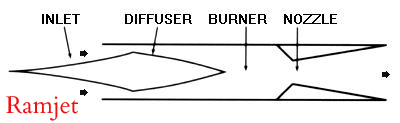
A ramjet engine.
    A ramjet has no moving parts and achieves compression of intake air by the forward speed of the air vehicle. Air entering the intake of a supersonic aircraft is slowed by aerodynamic diffusion created by the inlet and diffuser to velocities comparable to those in a turbojet augmentor. The expansion of hot gases, after fuel injection and combustion, accelerates the exhaust air to a velocity higher than that at the inlet and creates positive push.


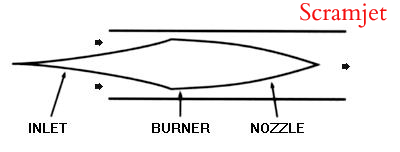
A scramjet engine.
    Scramjet is an acronym for Supersonic Combustion Ramjet. The scramjet differs from the ramjet in that combustion takes place at supersonic air velocities through the engine. It is mechanically simple, but vastly more aerodynamically complex than a jet engine. Hydrogen is normally the fuel used.


The Turbojet engine


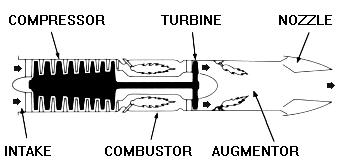
A turbojet engine.
    The turbojet is the basic engine of the jet age. Air is drawn into the engine through the front intake. The compressor squeezes the air to many times normal atmospheric pressure and forces it into the combustor. Here, fuel is sprayed into the compressed air, is ignited and burned continuously like a blowtorch. The burning gases expand rapidly rearward and pass through the turbine. The turbine extracts energy from the expanding gases to drive the compressor, which intakes more air. After leaving the turbine, the hot gases exit at the rear of the engine, giving the aircraft its forward push ... action, reaction !

    For additional thrust or power, an afterburner or augmentor can be added. Additional fuel is introduced into the hot exhaust and burned with a resultant increase of up to 50 percent in engine thrust by way of even higher velocity and more push.

The Turbofan engine


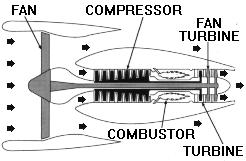
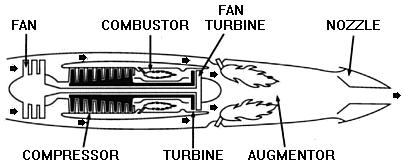
A high bypass turbofan engine.
    A turbofan engine is basically a turbojet to which a fan has been added. Large fans can be placed at either the front or rear of the engine to create high bypass ratios for subsonic flight. In the case of a front fan, the fan is driven by a second turbine, located behind the primary turbine that drives the main compressor. The fan causes more air to flow around (bypass) the engine. This produces greater thrust and reduces specific fuel consumption.
A low bypass turbofan engine.
For supersonic flight, a low bypass fan is utilized, and an
augmentor (afterburner) is added for additional thrust.


Ultra High Bypass Jet engine


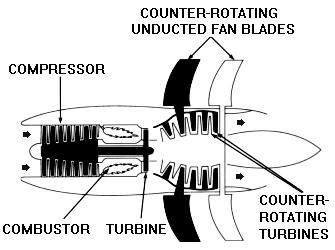
A high bypass turbofan engine.
    A logical approach to improving fuel consumption is even higher bypass technology. Mechanical arrangements can vary. During the 1980s, GE developed the Unducted Fan UDF® engine which eliminated the need for a gearbox to drive a large fan. The jet exhaust drives two counter-rotating turbines that are directly coupled to the fan blades. These large span fan blades, made of composite materials, have variable pitch to provide the proper blade angle of attack to meet varying aircraft speed and power requirements. Powerplants such as the UDF® engine are capable of reducing specific fuel consumption another 20-30 percent below current subsonic turbofans.


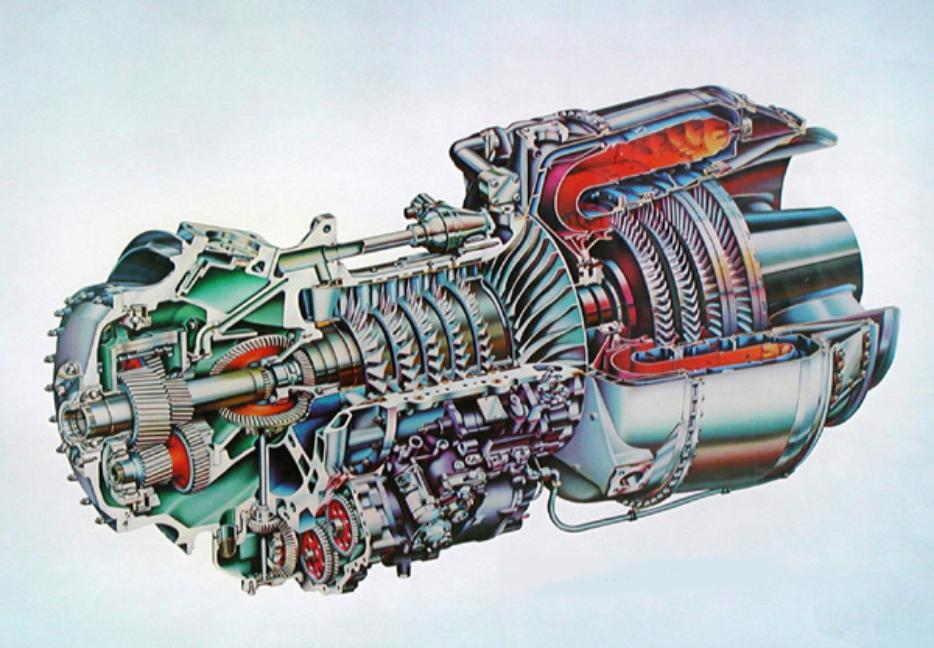
The Lycoming 1,400 shp (1,000 kW) T53-L-13 with a four stage turbine.


    The Lycoming T53, (company designation LTC-1) is a turboshaft engine used primarily on helicopters, but also fixed-wing turboprop aircraft. It was developed in response to a 1952 Air Force request for a 500 to 700 shaft horsepower (shp) (373 to 522 kW) turboprop engine. It was designed by a team headed by Anselm Franz at the Lycoming Turbine Engine Division in Stratford, Connecticut. Anselm Franz was the chief designer of the famed Junkers Jumo 004 that powered the world's first operational jet fighter, the Messerschmitt Me 262. Lycoming is most noted for producing a series of four and six cylinder engines for light aircraft. The T53 gave Lycoming its start in the aircraft gas turbine business.

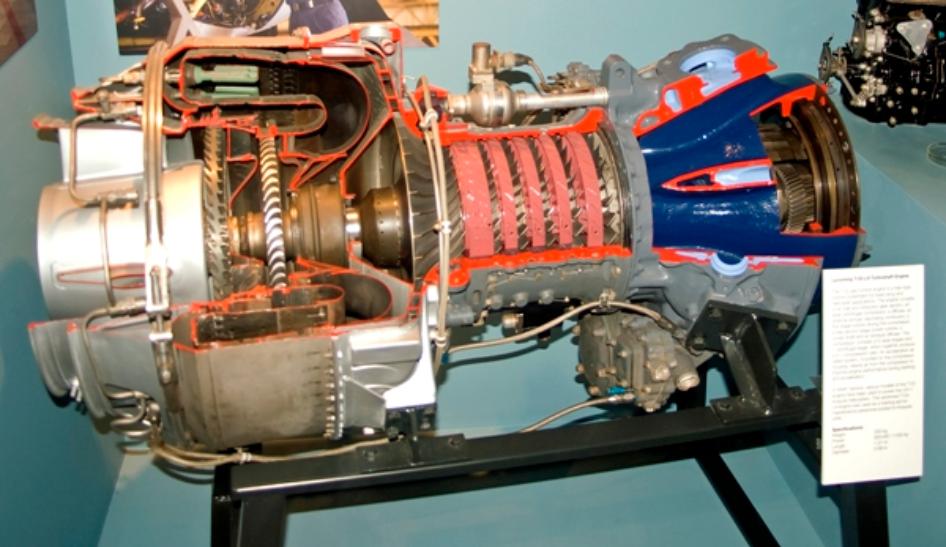
    The T53 was first delivered in 1959 and used a front-drive, concentric-shaft arrangement with a single spool five-stage axial compressor and sixth-stage centrigugal flow compressor. The compressed air then flows to a reverse flow combustor to a double spool, four-stage, axial-flow free turbine. The High Pressure (HP) turbine drives the compressor and accessory gearbox, while the Low Pressure (LP) turbine drives the output gearbox.
    The engine contains two gearboxes. The output gearbox on the cold end to drives the main rotor, the N2 governor, the N2 tach generator and a torquemeter. The accessory gearbox drives the starter/generator, oil pumps, fuel pumps and fuel control.

    Intake air flows around the output gearbox into the compressor section. The compressor contains variable inlet-guide-vanes to provide more efficient air flow and to improve acceleration. Air is bled from the compressor fourth and fifth stages to prevent compressor stalls, increase acceleration and to provide anti-icing and cabin air.

    The compressor discharge air is fed to a reverse flow annular burner can containing 22 fuel nozzles.


The Lycoming 1,400 shp (1,000 kW) T53-L-13 with a four stage turbine.

     The heated high pressure gas is expanded through the HP turbine, to drive the compressor and the accessory gearbox, and then through the LP turbine to drive the output reduction gearbox through a coaxial shaft. The LP turbine shaft rotates inside the center of the HP turbine shaft to the output gearbox.

    The output gearbox reduces the LP turbine speed from 22,500 rpm down to 6,640 rpm. The multiplying torque factor is 3-1/2. Theoretical peak torque for this engine is on the order of 2,200 lb/ft, but the gearbox is limited to around 1,700 lb/ft. The engine exhaust escapes through a large diameter diffuser at the rear of the engine.

    The first Lycoming T53-L-1A engine produced 700 shp (520 kW). Further development led to the T53-L-5 and produced 960 shp (720 kW).1 The T53-L-11 produced 1,100 shp (820 kW) and the T53-L-13 produced 1,400 shp (1,000 kW). The latest version of the T53, the T53-L-703, is rated at 1,800 shp (1340 kW).

    The first production T53-L-1A engine powered the first Bell UH-1A Iroquois (Huey,) ( Bell UH-1A Iroquois (Huey ), the and AH-1 Cobra helicopters and the Grumman OV-1 Mohawk airplane. The higher power T53-L-13 engine began deliveries in August 1966 and powered the Bell HU-1C/D/H Iroquois, Bell AH-1G Cobra and U.S. Air Force Kaman HH-43B helicopter.

    More than 19,000 T53s have been delivered and is now produced by Honeywell Aerospace.


The Lycoming 825 hp (615 kW) T53-L-9 with a two stage turbine.


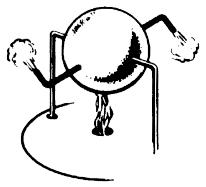
    Centuries ago in 100 A.D., Hero, a Greek philosopher and mathematician, demonstrated jet power in a machine called an "aeolipile." A heated, water filled steel ball with nozzles spun as steam escaped.
    Over the course of the past last half century, jet-powered flight has vastly changed the way we all live. However, the basic principle of jet propulsion is neither new nor complicated.

    Centuries ago in 100 A.D., Hero, a Greek philosopher and mathematician, demonstrated jet power in a machine called an "aeolipile." A heated, water filled steel ball with nozzles spun as steam escaped. Why? The principle behind this phenomenon was not fully understood until 1690 A.D. when Sir Isaac Newton in England formulated the principle of Hero's jet propulsion "aeolipile" in scientific terms. His Third Law of Motion stated: "Every action produces a reaction ... equal in force and opposite in direction."

    The jet engine of today operates according to this same basic principle. Jet engines contain three common components: the compressor, the combustor, and the turbine. To this basic engine, other components may be added, including:

  • A nozzle to recover and direct the gas energy and possibly divert the thrust for vertical takeoff and landing as well as changing direction of aircraft flight.

  • An afterburneror augmentor, a long "tailpipe" behind the turbine into which additional fuel is sprayed and burned to provide additional thrust.

  • A thrust reverser, which blocks the gas rushing toward the rear of the engine, thus forcing the gases forward to provide additional braking of aircraft.

  • A fan in front of the compressor to increase thrust and reduce fuel consumption.

  • An additional turbine that can be utilized to drive a propeller or helicopter rotor.