The FIFTH AIR FORCE (PACAF) 319th. Bomb Squadron
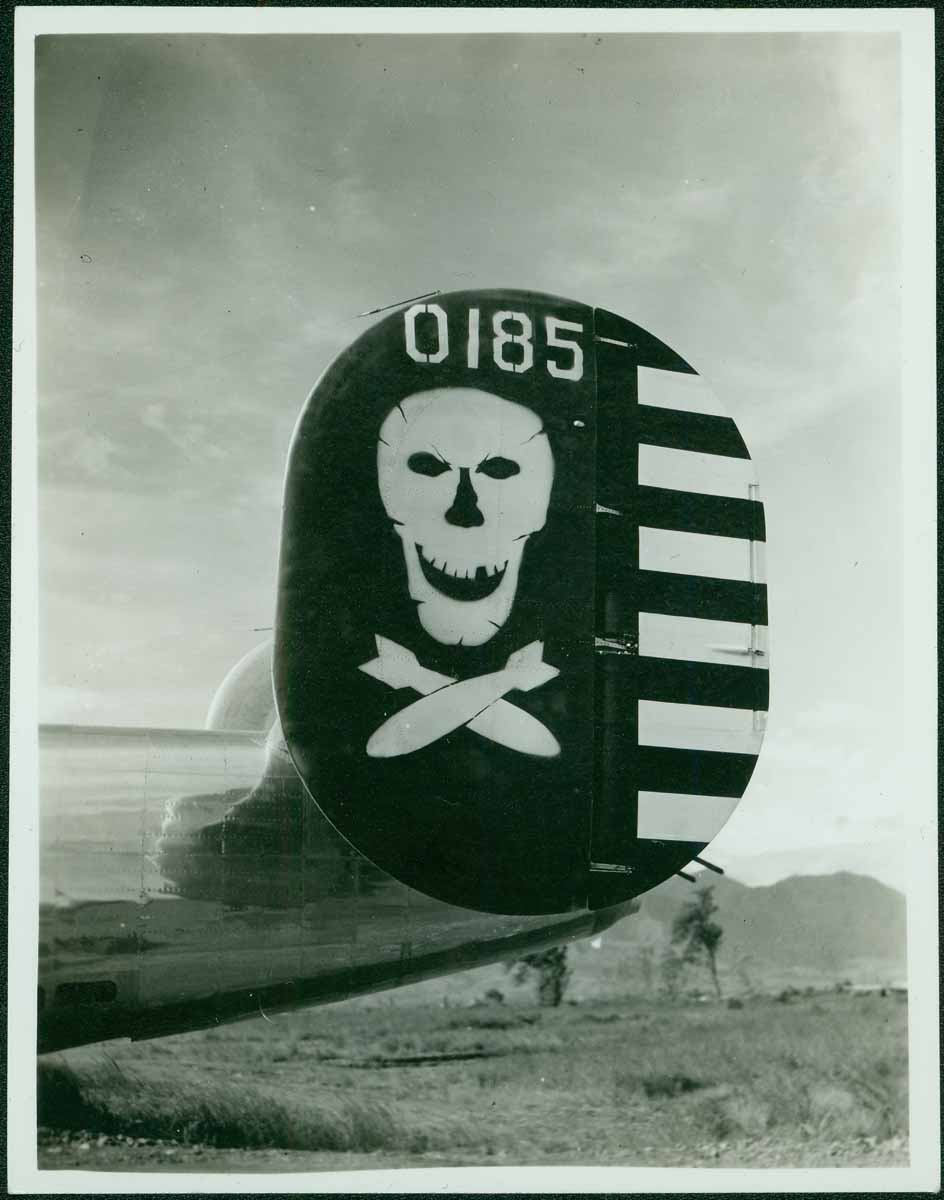
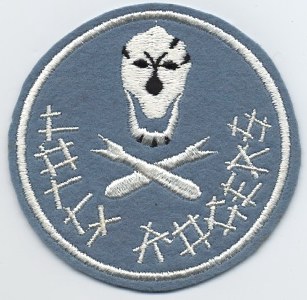
The 319th Bomb Squadron was the first to arrive in Australia. They arrived at Amberley Airfield west of Brisbane on 23 October 1942 after a long 11 hour trip from Nandi on the island of Viti Levi in the Fiji Islands. They flew to Mareeba Airfield in north Queensland on 24 October 1942 after short stopover at Garbutt Airfield in Townsville.
Lineage. Established as Philippine Department Air Force on 16 Aug 1941. Activated on 20 Sep 1941. Redesignated as: Far East Air Force on 28 Oct 1941; 5 Air Force on 5 Feb 1942; Fifth Air Force on 18 Sep 1942.
Assignments. Philippine Department, U.S. Army, 20 Sep 1941; Southwest Pacific Area, 2 Nov 1942; Far East Air Forces (Provisional), 15 Jun 1944; Far East Air Forces (later, Pacific Air Command, U.S. Army; Far East Air Forces; Pacific Air Forces), 3 Aug 1944-.
Major Components. Commands. V Air Force Service: 18 Jun 1943-15 Jun 1944. V Air Service Area: 9 Jan 1944-15 Jun 1944. 5 Bomber (later, V Bomber): 14 Nov 1941-31 May 1946. V Fighter: 25 Aug 1942-31 May 1946. 5 Interceptor: 4 Nov 1941-6 Apr 1942. Far East Air Service (later, 5 Air Force Base; V Air Force Base): 28 Oct 1941-2 Nov 1942.
Divisions: 39 Air: 1 Sep 1954-15 Jan 1968. 41 Air: 1 Sep 1954-15 Jan 1968. 43 Air: 1 Sep 1954-1 Oct 1957. 313 Air: 1 Mar 1955-1 Oct 1991. 314 Air: 31 May 1946-1 Mar 1950; 1 Dec 1950-18 May 1951; 15 Mar 1955-8 Sep 1986. 315 Air (formerly, 315 Composite Wing): 1 Jun 1946-1 Mar 1950.
Wings: 18: 1 Oct 1991-. 35 Fighter: 1 Oct 1994-. 374 Airlift: 1 Apr 1992-.
Stations. Nichols Field, Luzon, 20 Sep 1941; Darwin, Australia, 31 Dec 1941; Bandoeng, Java, 18 Jan 1942; Brisbane, Australia, c. Mar 1942; Nadzab, New Guinea, 15 Jun 1944; Owi, Schouten Islands, 10 Aug 1944; Burauen, Leyte, c. 20 Nov 1944; San Jose, Mindoro, Jan 1945; Clark Field, Luzon, Apr 1945; Hamasaki, Okinawa, 4 Aug 1945; Irumagawa, Japan, c. 25 Sep 1945; Tokyo, Japan, 13 Jan 1946; Nagoya, Japan, 20 May 1946; Seoul, Korea, 1 Dec 1950; Taegu, Korea, 22 Dec 1950; Seoul, Korea, 15 Jun 1951; Osan-Ni, Korea, 25 Jan 1954; Nagoya AB (later, Nagoya AS; Moriyama AS), Japan, 1 Sep 1954; Fuchu AS, Japan, 1 Jul 1957; Yokota AB, Japan, 11 Nov 1974-.
Commanders. Brig Gen Henry B. Clagett, 20 Sep 1941; Maj Gen Lewis H. Brereton, 7 Oct 1941-24 Feb 1942; None (not manned), 25 Feb 1942-2 Sep 1942; Lt Gen George C. Kenney, 3 Sep 1942; Lt Gen Ennis C. Whitehead, 15 Jun 1944; Maj Gen Kenneth B. Wolfe, 4 Oct 1945; Maj Gen Thomas D. White, 16 Jan 1948; Lt Gen Earle E. Partridge, 6 Oct 1948; Maj Gen Edward J. Timberlake, 21 May 1951; Maj Gen Frank F. Everest, 1 Jun 1951; Lt Gen Glenn O. Barcus, 30 May 1952; Lt Gen Samuel E. Anderson, 31 May 1953; Lt Gen Roger M. Ramey, 1 Jun 1954; Lt Gen Frederic H. Smith Jr., 20 Jun 1956; Lt Gen Robert W. Burns, 4 Aug 1958; Maj Gen Robert F. Tate, 6 Jul 1961 (temporary); Lt Gen Jacob E. Smart, 2 Aug 1961; Lt Gen Maurice A. Preston, 30 Jul 1963; Lt Gen Seth J. McKee, 1 Aug 1966; Lt Gen Thomas K. McGehee, 13 Jul 1968; Lt Gen Gordon M. Graham, 24 Feb 1970; Lt Gen Robert E. Pursley, 15 Nov 1972; Maj Gen Edward P. McNeff, 1 Mar 1974 (temporary); Lt Gen Walter T. Galligan, 8 May 1974; Lt Gen George G. Loving Jr., 22 Jun 1977; Lt Gen William H. Ginn Jr.,14 Jun 1979; Lt Gen Charles L. Donnelly Jr., 5 Aug 1981; Lt Gen Edward L. Tixier, 19 Jul 1984; Lt Gen James B. Davis, 22 Jan 1988; Brig Gen James M. Johnston III, 18 Jul 1991 (temporary); Lt Gen Richard E. Hawley, 9 Aug 1991; Lt Gen Richard B. Myers, 13 Nov 1993; Lt Gen Ralph E. Eberhart, 18 Jun 1996; Lt Gen John B. Hall Jr., 27 Jun 1997; Lt Gen Paul V. Hester, 3 Sep 1999; Lt Gen Thomas C. Waskow, 19 Nov 2001; Lt Gen Bruce A. Wright, 10 Feb 2005; Maj Gen Edward A. Rice Jr., 25 Feb 2008-.
Operations. One of the few numbered air forces never stationed in the United States. Engaged in early combat on Luzon in December 1941, and later fought on in Java from January-February 1942 as part of the Allied effort to stem the Japanese thrust at Australia. Although unmanned from March-August 1942, the air force became directly involved from September 1942 onward in the island hopping campaigns in the Southwest Pacific during World War II and remained as part of the occupation force in Japan following the war. Served as the combat air force in Korea during the Korean conflict, after which it returned to Japan. Responsible for maintaining a strong tactical posture for the defense of Japan, South Korea, and the northwestern Pacific; played a critical role in helping establish Japan's and the Republic of Korea's modern air forces. Supported training activities with nations in the Pacific area; provided forces to contingencies worldwide; served as air component to US Forces Japan, 2004-.
Service Streamers. None.
Campaign Streamers. World War II: Philippine Islands; East Indies; Papua; New Guinea; Bismarck Archipelago; Leyte; Luzon; Southern Philippines. Korea: UN Defensive; UN Offensive; CCF Intervention; First UN Counteroffensive; CCF Spring Offensive; UN Summer-Fall Offensive; Second Korean Winter; Korea, Summer-Fall 1952; Third Korean Winter; Korea, Summer-Fall 1953.
Armed Forces Expeditionary Streamers. None.
Decorations. Distinguished Unit Citations: Philippine Islands, 8-22 Dec 1941; Philippine Islands, 7 Dec 1941-10 May 1942; Papua, [Sep] 1942-23 Jan 1943. Air Force Outstanding Unit Awards: 1 Aug 1987-31 Jul 1989; 1 Oct 1994-30 Sep 1996; 1 Oct 1998-30 Sep 2000; 1 Jan 2005-30 Sep 2006. Philippine Presidential Unit Citation. Republic of Korea Presidential Unit Citations: 24 Jul 1950-15 Mar 1951; 16 Mar 1951-30 Sep 1952; 1 Oct 1952-27 Jul 1953; 1 Sep-14 Nov 1983.
Fenton Airfield
Fenton Airfield was a World War II military airfield located at Tipperary Station, Hayes Creek, Northern Territory, Australia.
Abandoned since 1945, the site is an outstanding example of a World War II heavy bomber airfield construction and layout, and is one of three surviving examples of heavy bomber airfields in the Katherine-Darwin region.
The airfield is open to the public; the main runway, taxiways and hardstands are accessible. Remnants of the control tower remain and items of aircraft wreckage can be found in the area.
History
The airfield was built by C Company and HQ Detachment of the 808th Engineer Aviation Battalion between 27 April 1942 and 16 July 1942. The airfield was named after Flight Lieutenant Clyde Fenton. The single runway was 6,000 ft (1,828.8m) long and 100 ft (30.48m) wide.
It was mainly utilised by Liberator bombers mounting long range raids against Japanese forces in the Netherlands East Indies North Western Area of Operations and the South West Pacific Area.
Further development of the airfield was undertaken by No. 1 Airfield Construction Squadron RAAF, No 14 Airfield Construction Squadron RAAF and New South Wales Department of Main Roads under the Allied Works Council. The runway was enlarged to approximately 7,218 ft (2,200m) long and 164 ft (50m) wide and about sixty aircraft dispersal bays, some with earthen revetments.
During its operational use Fenton Airfield was a major airfield, being headquarters for many Royal Australian Air Force Squadrons, and United States Army and Air Force units. Reconnaissance flights were flown over Timor Island, New Guinea and Celebres Islands, and attacks and armed reconnaissance missions were carried out against Japanese airfields, ground installations and shipping. On 29 February 1944 the USAAF 380th Bombardment Group flew a 16-hour mission from Fenton to Borneo, flying over 2,500 nautical miles (4,000 km).
With the end of the war in late 1945, the airfield was abandoned. Over the years, it has reverted in large part to the natural terrain from which it was built. All of the base infrastructure is gone, with concrete and various foundations, piles of rubble and the occasional aircraft part remaining. In aerial photographs, the remains of some roads that probably led to dispersed parts of the base away from the operations area such as the bomb dump and the administrative containment area are faintly visible, but no structures exist.
Units based at Fenton Airfield
No. 1 Airfield Construction Squadron RAAF
No. 6 Repair and Salvage Unit RAAF
No. 11 Signals Unit RAAF
No. 14 Airfield Construction Squadron RAAF
No. 21 Squadron RAAF (B-24)
No. 23 Squadron RAAF (B-24)
No. 24 Squadron RAAF (B-24)
82nd Wing RAAF (No.'s 21, 23 & 24 Squadrons RAAF)
United States Army Air Force Fifth Air Force
64th Bombardment Squadron (43d Bombardment Group), B-17 Flying Fortress 2 August-25 September 1942 43d Materiel Squadron 319th Bombardment Squadron (90th Bombardment Group), B-24 Liberator, 5 February-23 June 1943 Deployed from: RAAF Base Darwin, NT 380th Bombardment Group, B-24 Liberator, May 1943-9 August 1944 528th Bombardment Squadron, 28 April 1943 – 20 August 1944 529th Bombardment Squadron Assigned to: Manbulloo Airfield, NT, 28 April-7 November 1943 Assigned to: Long Airfield, NT, 7 November-10 July 1944 Assigned to: RAAF Base Darwin, NT, 10 July-February 1945 530th Bombardment Squadron 531st Bombardment Squadron Assigned to: Manbulloo Airfield, NT, 28 April-5 December 1943 Assigned to: Long Airfield, NT, 5 December-21 July 1944 Assigned to: RAAF Base Darwin, NT, 25 July-1 March 1945 808th Engineer Aviation Battalion, United States Army
404th Quartermaster Air Depot Platoon, United States Army
Japanese Bombing Raids on Fenton Airfield
30 June 1943 (12:30pm)
6 July 1943 (12:02pm)
13 August 1943 (9:45pm)
13 August 1943 (11:12 pm)
21 August 1943 (03:07 am)
15 September 1943 (00:25 am)
18 September 1943 (03:50 am)
