Jet engines

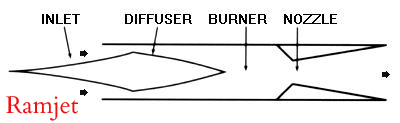
| A ramjet engine. | |
| A ramjet has no moving parts and achieves compression of intake air by the forward speed of the air vehicle. Air entering the intake of a supersonic aircraft is slowed by aerodynamic diffusion created by the inlet and diffuser to velocities comparable to those in a turbojet augmentor. The expansion of hot gases, after fuel injection and combustion, accelerates the exhaust air to a velocity higher than that at the inlet and creates positive push. |
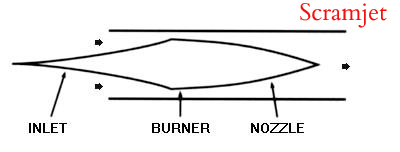
| A scramjet engine. | |
| Scramjet is an acronym for Supersonic Combustion Ramjet. The scramjet differs from the ramjet in that combustion takes place at supersonic air velocities through the engine. It is mechanically simple, but vastly more aerodynamically complex than a jet engine. Hydrogen is normally the fuel used. |
The Turbojet engine

The turbojet is the basic engine of the jet age. Air is drawn into the engine through the front intake. The compressor squeezes the air to many times normal atmospheric pressure and forces it into the combustor. Here, fuel is sprayed into the compressed air, is ignited and burned continuously like a blowtorch. The burning gases expand rapidly rearward and pass through the turbine. The turbine extracts energy from the expanding gases to drive the compressor, which intakes more air. After leaving the turbine, the hot gases exit at the rear of the engine, giving the aircraft its forward push ... action, reaction !
For additional thrust or power, an afterburner or augmentor can be added. Additional fuel is introduced into the hot exhaust and burned with a resultant increase of up to 50 percent in engine thrust by way of even higher velocity and more push.
